


Page 18 - Euclid's Elements of Geometry
P. 18
ST	EW      aþ.

                                    igþ                         given point C, which is not on (AB). (Which is) the very


                                                                                            ELEMENTS BOOK 1


                                                                thing it was required to do.

                                                                                 Proposition 13
                                      .
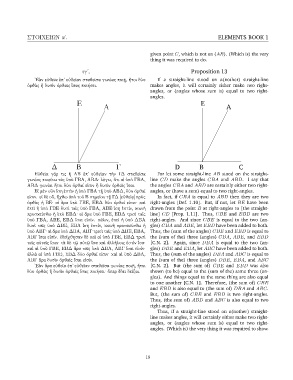
               ᾿Εὰν εὐθεῖα ἐπ᾿ εὐθεῖαν σταθεῖσα γωνίας ποιῇ, ἤτοι δύο  If a straight-line stood on a(nother) straight-line
            ὀρθὰς ἢ δυσὶν ὀρθαῖς ἴσας ποιήσει.                  makes angles, it will certainly either make two right-
                                                                angles, or (angles whose sum is) equal to two right-
                                                                angles.
                                 Ε                                                   E
                                            Α                                                   A


                       ∆         Β                Γ                       D         B                C
               Εὐθεῖα γάρ τις ἡ ΑΒ ἐπ᾿ εὐθεῖαν τὴν ΓΔ σταθεῖσα     For let some straight-line AB stood on the straight-
            γωνίας ποιείτω τὰς ὑπὸ ΓΒΑ, ΑΒΔ· λὲγω, ὅτι αἱ ὑπὸ ΓΒΑ, line CD make the angles CBA and ABD. I say that
            ΑΒΔ γωνίαι ἤτοι δύο ὀρθαί εἰσιν ἢ δυσὶν ὀρθαῖς ἴσαι.  the angles CBA and ABD are certainly either two right-
               Εἰ μὲν οὖν ἴση ἐστὶν ἡ ὑπὸ ΓΒΑ τῇ ὑπὸ ΑΒΔ, δύο ὀρθαί  angles, or (have a sum) equal to two right-angles.
            εἰσιν. εἰ δὲ οὔ, ἤχθω ἀπὸ τοῦ Β σημείου τῇ ΓΔ [εὐθείᾳ] πρὸς  In fact, if CBA is equal to ABD then they are two
            ὀρθὰς ἡ ΒΕ· αἱ ἄρα ὑπὸ ΓΒΕ, ΕΒΔ δύο ὀρθαί εἰσιν· καὶ right-angles [Def. 1.10]. But, if not, let BE have been
            ἐπεὶ ἡ ὑπὸ ΓΒΕ δυσὶ ταῖς ὑπὸ ΓΒΑ, ΑΒΕ ἴση ἐστίν, κοινὴ drawn from the point B at right-angles to [the straight-
            προσκείσθω ἡ ὑπὸ ΕΒΔ· αἱ ἄρα ὑπὸ ΓΒΕ, ΕΒΔ τρισὶ ταῖς line] CD [Prop. 1.11]. Thus, CBE and EBD are two
            ὑπὸ ΓΒΑ, ΑΒΕ, ΕΒΔ ἴσαι εἰσίν. πάλιν, ἐπεὶ ἡ ὑπὸ ΔΒΑ right-angles. And since CBE is equal to the two (an-
            δυσὶ ταῖς ὑπὸ ΔΒΕ, ΕΒΑ ἴση ἐστίν, κοινὴ προσκείσθω ἡ  gles) CBA and ABE, let EBD have been added to both.
            ὑπὸ ΑΒΓ· αἱ ἄρα ὑπὸ ΔΒΑ, ΑΒΓ τρισὶ ταῖς ὑπὸ ΔΒΕ, ΕΒΑ,  Thus, the (sum of the angles) CBE and EBD is equal to
            ΑΒΓ ἴσαι εἰσίν. ἐδείχθησαν δὲ καὶ αἱ ὑπὸ ΓΒΕ, ΕΒΔ τρισὶ  the (sum of the) three (angles) CBA, ABE, and EBD
            ταῖς αὐταῖς ἴσαι· τὰ δὲ τῷ αὐτῷ ἴσα καὶ ἀλλήλοις ἐστὶν ἴσα· [C.N. 2]. Again, since DBA is equal to the two (an-
            καὶ αἱ ὑπὸ ΓΒΕ, ΕΒΔ ἄρα ταῖς ὑπὸ ΔΒΑ, ΑΒΓ ἴσαι εἰσίν· gles) DBE and EBA, let ABC have been added to both.
            ἀλλὰ αἱ ὑπὸ ΓΒΕ, ΕΒΔ δύο ὀρθαί εἰσιν· καὶ αἱ ὑπὸ ΔΒΑ, Thus, the (sum of the angles) DBA and ABC is equal to
            ΑΒΓ ἄρα δυσὶν ὀρθαῖς ἴσαι εἰσίν.                    the (sum of the) three (angles) DBE, EBA, and ABC
               ᾿Εὰν ἄρα εὐθεῖα ἐπ᾿ εὐθεῖαν σταθεῖσα γωνίας ποιῇ, ἤτοι [C.N. 2]. But (the sum of) CBE and EBD was also
            δύο ὀρθὰς ἢ δυσὶν ὀρθαῖς ἴσας ποιήσει· ὅπερ ἔδει δεῖξαι.  shown (to be) equal to the (sum of the) same three (an-
                                                                gles). And things equal to the same thing are also equal
                                                                to one another [C.N. 1]. Therefore, (the sum of) CBE
                                                                and EBD is also equal to (the sum of) DBA and ABC.
                                                                But, (the sum of) CBE and EBD is two right-angles.
                                                                Thus, (the sum of) ABD and ABC is also equal to two
                                                                right-angles.
                                                                   Thus, if a straight-line stood on a(nother) straight-
                                                                line makes angles, it will certainly either make two right-
                                                                angles, or (angles whose sum is) equal to two right-
                                                                angles. (Which is) the very thing it was required to show.


                                                              18

