


Page 139 - Euclid's Elements of Geometry
P. 139
ST	EW      eþ.


                                          A E B

                                        G
             G    E A B           Z                  H          A  E     B                ELEMENTS BOOK 5
                    H Z
                                                                                             A
                                                                                                    E B
                                                              C  F    G           H       C  F         G     H
             D
                                        D


                                                                                            K
                                                                K


                                                                D
                                                                                            D


                                                                                            L
                                                                                            M
                                                                M
                                                                                            N
                                                                N
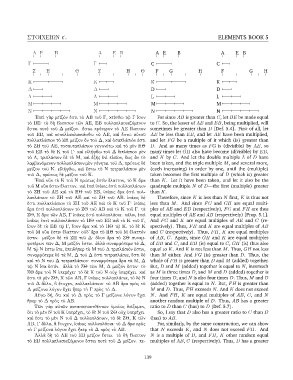
               ᾿Επεὶ γὰρ μεῖζόν ἐστι τὸ ΑΒ τοῦ Γ, κείσθω τῷ Γ ἴσον  L  For since AB is greater than C, let BE be made equal
            τὸ ΒΕ· τὸ δὴ ἔλασσον τῶν ΑΕ, ΕΒ πολλαπλασιαζόμενον to C. So, the lesser of AE and EB, being multiplied, will
            ἔσται ποτὲ τοῦ Δ μεῖζον. ἔστω πρότερον τὸ ΑΕ ἔλαττον sometimes be greater than D [Def. 5.4]. First of all, let
            τοῦ ΕΒ, καὶ πεπολλαπλασιάσθω τὸ ΑΕ, καὶ ἔστω αὐτοῦ AE be less than EB, and let AE have been multiplied,
            πολλαπλάσιον τὸ ΖΗ μεῖζον ὂν τοῦ Δ, καὶ ὁσαπλάσιόν ἐστι  and let FG be a multiple of it which (is) greater than
            τὸ ΖΗ τοῦ ΑΕ, τοσαυταπλάσιον γεγονέτω καὶ τὸ μὲν ΗΘ  D. And as many times as FG is (divisible) by AE, so
            τοῦ ΕΒ τὸ δὲ Κ τοῦ Γ· καὶ εἰλήφθω τοῦ Δ διπλάσιον μὲν many times let GH also have become (divisible) by EB,
            τὸ Λ, τριπλάσιον δὲ τὸ Μ, καὶ ἑξῆς ἑνὶ πλεῖον, ἕως ἂν τὸ  and K by C. And let the double multiple L of D have
            λαμβανόμενον πολλαπλάσιον μὲν γένηται τοῦ Δ, πρώτως δὲ  been taken, and the triple multiple M, and several more,
            μεῖζον τοῦ Κ. εἰλήφθω, καὶ ἔστω τὸ Ν τετραπλάσιον μὲν (each increasing) in order by one, until the (multiple)
            τοῦ Δ, πρώτως δὲ μεῖζον τοῦ Κ.                      taken becomes the first multiple of D (which is) greater
               ᾿Επεὶ οὖν τὸ Κ τοῦ Ν πρώτως ἐστὶν ἔλαττον, τὸ Κ ἄρα than K. Let it have been taken, and let it also be the
            τοῦ Μ οὔκ ἐστιν ἔλαττον. καὶ ἐπεὶ ἰσάκις ἐστὶ πολλαπλάσιον quadruple multiple N of D—the first (multiple) greater
            τὸ ΖΗ τοῦ ΑΕ καὶ τὸ ΗΘ τοῦ ΕΒ, ἰσάκις ἄρα ἐστὶ πολ- than K.
            λαπλάσιον τὸ ΖΗ τοῦ ΑΕ καὶ τὸ ΖΘ τοῦ ΑΒ. ἰσάκις δέ     Therefore, since K is less than N first, K is thus not
            ἐστι πολλαπλάσιον τὸ ΖΗ τοῦ ΑΕ καὶ τὸ Κ τοῦ Γ· ἰσάκις less than M. And since FG and GH are equal multi-
            ἄρα ἐστὶ πολλαπλάσιον τὸ ΖΘ τοῦ ΑΒ καὶ τὸ Κ τοῦ Γ. τὰ  ples of AE and EB (respectively), FG and FH are thus
            ΖΘ, Κ ἄρα τῶν ΑΒ, Γ ἰσάκις ἐστὶ πολλαπλάσια. πάλιν, ἐπεὶ equal multiples of AE and AB (respectively) [Prop. 5.1].
            ἰσάκις ἐστὶ πολλαπλάσιον τὸ ΗΘ τοῦ ΕΒ καὶ τὸ Κ τοῦ Γ, And FG and K are equal multiples of AE and C (re-
            ἴσον δὲ τὸ ΕΒ τῷ Γ, ἴσον ἄρα καὶ τὸ ΗΘ τῷ Κ. τὸ δὲ Κ  spectively). Thus, FH and K are equal multiples of AB
            τοῦ Μ οὔκ ἐστιν ἔλαττον· οὐδ᾿ ἄρα τὸ ΗΘ τοῦ Μ ἔλαττόν and C (respectively). Thus, FH, K are equal multiples
            ἐστιν. μεῖζον δὲ τὸ ΖΗ τοῦ Δ· ὅλον ἄρα τὸ ΖΘ συναμ- of AB, C. Again, since GH and K are equal multiples
            φοτέρων τῶν Δ, Μ μεῖζόν ἐστιν. ἀλλὰ συναμφότερα τὰ Δ, of EB and C, and EB (is) equal to C, GH (is) thus also
            Μ τῷ Ν ἐστιν ἴσα, ἐπειδήπερ τὸ Μ τοῦ Δ τριπλάσιόν ἐστιν, equal to K. And K is not less than M. Thus, GH not less
            συναμφότερα δὲ τὰ Μ, Δ τοῦ Δ ἐστι τετραπλάσια, ἔστι δὲ  than M either. And FG (is) greater than D. Thus, the
            καὶ τὸ Ν τοῦ Δ τετραπλάσιον· συναμφότερα ἄρα τὰ Μ, Δ whole of FH is greater than D and M (added) together.
            τῷ Ν ἴσα ἐστίν. ἀλλὰ τὸ ΖΘ τῶν Μ, Δ μεῖζόν ἐστιν· τὸ  But, D and M (added) together is equal to N, inasmuch
            ΖΘ ἄρα τοῦ Ν ὑπερέχει· τὸ δὲ Κ τοῦ Ν οὐχ ὑπερέχει. καί as M is three times D, and M and D (added) together is
            ἐστι τὰ μὲν ΖΘ, Κ τῶν ΑΒ, Γ ἰσάκις πολλαπλάσια, τὸ δὲ Ν four times D, and N is also four times D. Thus, M and D
            τοῦ Δ ἄλλο, ὃ ἔτυχεν, πολλαπλάσιον· τὸ ΑΒ ἄρα πρὸς τὸ  (added) together is equal to N. But, FH is greater than
            Δ μείζονα λόγον ἔχει ἤπερ τὸ Γ πρὸς τὸ Δ.           M and D. Thus, FH exceeds N. And K does not exceed
               Λέγω δή, ὅτι καὶ τὸ Δ πρὸς τὸ Γ μείζονα λόγον ἔχει N. And FH, K are equal multiples of AB, C, and N
            ἤπερ τὸ Δ πρὸς τὸ ΑΒ.                               another random multiple of D. Thus, AB has a greater
               Τῶν γὰρ αὐτῶν κατασκευασθέντων ὁμοίως δείξομεν, ratio to D than C (has) to D [Def. 5.7].
            ὅτι τὸ μὲν Ν τοῦ Κ ὑπερέχει, τὸ δὲ Ν τοῦ ΖΘ οὐχ ὑπερέχει.  So, I say that D also has a greater ratio to C than D
            καί ἐστι τὸ μὲν Ν τοῦ Δ πολλαπλάσιον, τὰ δὲ ΖΘ, Κ τῶν  (has) to AB.
            ΑΒ, Γ ἄλλα, ἃ ἔτυχεν, ἰσάκις πολλαπλάσια· τὸ Δ ἄρα πρὸς  For, similarly, by the same construction, we can show
            τὸ Γ μείζονα λόγον ἔχει ἤπερ τὸ Δ πρὸς τὸ ΑΒ.       that N exceeds K, and N does not exceed FH. And
               ᾿Αλλὰ δὴ τὸ ΑΕ τοῦ ΕΒ μεῖζον ἔστω. τὸ δὴ ἔλαττον N is a multiple of D, and FH, K other random equal
            τὸ ΕΒ πολλαπλασιαζόμενον ἔσται ποτὲ τοῦ Δ μεῖζον. πε- multiples of AB, C (respectively). Thus, D has a greater


                                                             139

