


Page 138 - Euclid's Elements of Geometry
P. 138
ST	EW      eþ.


                                                                                            ELEMENTS BOOK 5


                                                                same ratio to C, and (that) C (has the same ratio) to
                                                                each of A and B.
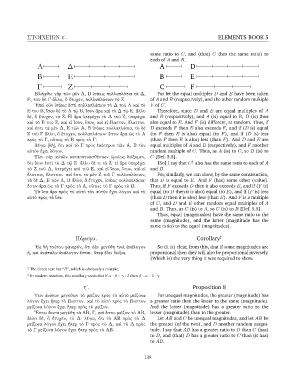
                 Α           ∆                                      A            D
                 Β           Ε                                      B            E

                 Γ           Ζ                                      C            F
               Εἰλήφθω γὰρ τῶν μὲν Α, Β ἰσάκις πολλαπλάσια τὰ Δ,   For let the equal multiples D and E have been taken
            Ε, τοῦ δὲ Γ ἄλλο, ὃ ἔτυχεν, πολλαπλάσιον τὸ Ζ.      of A and B (respectively), and the other random multiple
               ᾿Επεὶ οὖν ἰσάκις ἐστὶ πολλαπλάσιον τὸ Δ τοῦ Α καὶ τὸ  F of C.
            Ε τοῦ Β, ἴσον δὲ τὸ Α τῷ Β, ἴσον ἄρα καὶ τὸ Δ τῷ Ε. ἄλλο  Therefore, since D and E are equal multiples of A
            δέ, ὅ ἔτυχεν, τὸ Ζ. Εἰ ἄρα ὑπερέχει τὸ Δ τοῦ Ζ, ὑπερέχει and B (respectively), and A (is) equal to B, D (is) thus
            καὶ τὸ Ε τοῦ Ζ, καὶ εἰ ἴσον, ἴσον, καὶ εἰ ἔλαττον, ἔλαττον. also equal to E. And F (is) different, at random. Thus, if
            καί ἐστι τὰ μὲν Δ, Ε τῶν Α, Β ἰσάκις πολλαπλάσια, τὸ δὲ  D exceeds F then E also exceeds F, and if (D is) equal
            Ζ τοῦ Γ ἄλλο, ὃ ἔτυχεν, πολλαπλάσιον· ἔστιν ἄρα ὡς τὸ Α (to F then E is also) equal (to F), and if (D is) less
            πρὸς τὸ Γ, οὕτως τὸ Β πρὸς τὸ Γ.                    (than F then E is also) less (than F). And D and E are
               Λέγω [δή], ὅτι καὶ τὸ Γ πρὸς ἑκάτερον τῶν Α, Β τὸν equal multiples of A and B (respectively), and F another
            αὐτὸν ἔχει λόγον.                                   random multiple of C. Thus, as A (is) to C, so B (is) to
               Τῶν γὰρ αὐτῶν κατασκευασθέντων ὁμοίως δείξομεν, C [Def. 5.5].
                                                                                 †
            ὅτι ἴσον ἐστὶ τὸ Δ τῷ Ε· ἄλλο δέ τι τὸ Ζ· εἰ ἄρα ὑπερέχει  [So] I say that C also has the same ratio to each of A
            τὸ Ζ τοῦ Δ, ὑπερέχει καὶ τοῦ Ε, καὶ εἰ ἴσον, ἴσον, καὶ εἰ  and B.
            ἔλαττον, ἔλαττον. καί ἐστι τὸ μὲν Ζ τοῦ Γ πολλαπλάσιον,  For, similarly, we can show, by the same construction,
            τὰ δὲ Δ, Ε τῶν Α, Β ἄλλα, ἃ ἔτυχεν, ἰσάκις πολλαπλάσια· that D is equal to E. And F (has) some other (value).
                                 ìri  sma                      and B. Thus, as C (is) to A, so C (is) to B [Def. 5.5].
            ἔστιν ἄρα ὡς τὸ Γ πρὸς τὸ Α, οὕτως τὸ Γ πρὸς τὸ Β.  Thus, if F exceeds D then it also exceeds E, and if (F is)
               Τὰ ἴσα ἄρα πρὸς τὸ αὐτὸ τὸν αὐτὸν ἔχει λόγον καὶ τὸ  equal (to D then it is also) equal (to E), and if (F is) less
            αὐτὸ πρὸς τὰ ἴσα.                                   (than D then it is also) less (than E). And F is a multiple
                                                                of C, and D and E other random equal multiples of A

                                                                   Thus, equal (magnitudes) have the same ratio to the
                                                                same (magnitude), and the latter (magnitude has the
                                                                same ratio) to the equal (magnitudes).
                                    hþ                          (Which is) the very thing it was required to show.
                                         .
                                                                                   Corollary
                                                                                             ‡
               ᾿Εκ δὴ τούτου φανερόν, ὅτι ἐὰν μεγέθη τινὰ ἀνάλογον  So (it is) clear, from this, that if some magnitudes are
            ᾖ, καὶ ἀνάπαλιν ἀνάλογον ἔσται. ὅπερ ἔδει δεῖξαι.   proportional then they will also be proportional inversely.


            †  The Greek text has “E”, which is obviously a mistake.
            ‡  In modern notation, this corollary reads that if α : β :: γ : δ then β : α :: δ : γ.

                                                                                  Proposition 8
                                      .
               Τῶν ἀνίσων μεγεθῶν τὸ μεῖζον πρὸς τὸ αὐτὸ μείζονα   For unequal magnitudes, the greater (magnitude) has
            λόγον ἔχει ἤπερ τὸ ἔλαττον. καὶ τὸ αὐτὸ πρὸς τὸ ἔλαττον a greater ratio than the lesser to the same (magnitude).
            μείζονα λόγον ἔχει ἤπερ πρὸς τὸ μεῖζον.             And the latter (magnitude) has a greater ratio to the
               ῎Εστω ἄνισα μεγέθη τὰ ΑΒ, Γ, καὶ ἔστω μεῖζον τὸ ΑΒ, lesser (magnitude) than to the greater.
            ἄλλο δέ, ὃ ἔτυχεν, τὸ Δ· λέγω, ὅτι τὸ ΑΒ πρὸς τὸ Δ     Let AB and C be unequal magnitudes, and let AB be
            μείζονα λόγον ἔχει ἤπερ τὸ Γ πρὸς τὸ Δ, καὶ τὸ Δ πρὸς  the greater (of the two), and D another random magni-
            τὸ Γ μείζονα λόγον ἔχει ἤπερ πρὸς τὸ ΑΒ.            tude. I say that AB has a greater ratio to D than C (has)
                                                                to D, and (that) D has a greater ratio to C than (it has)
                                                                to AB.


                                                             138

