


Page 145 - Euclid's Elements of Geometry
P. 145
ST	EW      eþ.                                                              ELEMENTS BOOK 5


                                    ieþ                         equal (to the third then the second will also be) equal (to


                                                                the fourth). And if (the first magnitude is) less (than the
                                                                third then the second will also be) less (than the fourth).
                                                                (Which is) the very thing it was required to show.

            †  In modern notation, this proposition reads that if α : β :: γ : δ then α T γ as β T δ.

                                                                                Proposition 15
                                      .
                                                                                                †
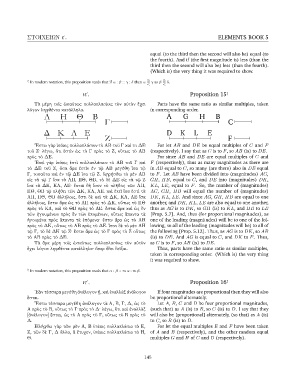
               Τὰ μέρη τοῖς ὡσαύτως πολλαπλασίοις τὸν αὐτὸν ἔχει   Parts have the same ratio as similar multiples, taken
            λόγον ληφθέντα κατάλληλα.                           in corresponding order.
                   Α      Η      Θ      Β                              A      G     H      B
                                             Γ                                                  C

                   ∆     Κ Λ        Ε                                  D    K     L     E
                                             Ζ                                                  F
               ῎Εστω γὰρ ἰσάκις πολλαπλάσιον τὸ ΑΒ τοῦ Γ καὶ το ΔΕ  For let AB and DE be equal multiples of C and F
            τοῦ Ζ· λέγω, ὅτι ἐστὶν ὡς τὸ Γ πρὸς τὸ Ζ, οὕτως τὸ ΑΒ  (respectively). I say that as C is to F, so AB (is) to DE.
            πρὸς τὸ ΔΕ.                                            For since AB and DE are equal multiples of C and
               ᾿Επεὶ γὰρ ἰσάκις ἐστὶ πολλαπλάσιον τὸ ΑΒ τοῦ Γ καὶ F (respectively), thus as many magnitudes as there are
            τὸ ΔΕ τοῦ Ζ, ὅσα ἄρα ἐστὶν ἐν τῷ ΑΒ μεγέθη ἴσα τῷ in AB equal to C, so many (are there) also in DE equal
            Γ, τοσαῦτα καὶ ἐν τῷ ΔΕ ἴσα τῷ Ζ. διῃρήσθω τὸ μὲν ΑΒ  to F. Let AB have been divided into (magnitudes) AG,
            εἰς τὰ τῷ Γ ἴσα τὰ ΑΗ, ΗΘ, ΘΒ, τὸ δὲ ΔΕ εἰς τὰ τῷ Ζ  GH, HB, equal to C, and DE into (magnitudes) DK,
            ἴσα τὰ ΔΚ, ΚΛ, ΛΕ· ἔσται δὴ ἴσον τὸ πλῆθος τῶν ΑΗ,  KL, LE, equal to F. So, the number of (magnitudes)
            ΗΘ, ΘΒ τῷ πλήθει τῶν ΔΚ, ΚΛ, ΛΕ. καὶ ἐπεὶ ἴσα ἐστὶ τὰ  AG, GH, HB will equal the number of (magnitudes)
            ΑΗ, ΗΘ, ΘΒ ἀλλήλοις, ἔστι δὲ καὶ τὰ ΔΚ, ΚΛ, ΛΕ ἴσα DK, KL, LE. And since AG, GH, HB are equal to one
            ἀλλήλοις, ἔστιν ἄρα ὡς τὸ ΑΗ πρὸς τὸ ΔΚ, οὕτως τὸ ΗΘ  another, and DK, KL, LE are also equal to one another,
            πρὸς τὸ ΚΛ, καὶ τὸ ΘΒ πρὸς τὸ ΛΕ. ἔσται ἄρα καὶ ὡς ἓν thus as AG is to DK, so GH (is) to KL, and HB to LE
            τῶν ἡγουμένων πρὸς ἓν τῶν ἑπομένων, οὕτως ἅπαντα τὰ  [Prop. 5.7]. And, thus (for proportional magnitudes), as
            ἡγουμένα πρὸς ἅπαντα τὰ ἑπόμενα· ἔστιν ἄρα ὡς τὸ ΑΗ  one of the leading (magnitudes) will be to one of the fol-
            πρὸς τὸ ΔΚ, οὕτως τὸ ΑΒ πρὸς τὸ ΔΕ. ἴσον δὲ τὸ μὲν ΑΗ  lowing, so all of the leading (magnitudes will be) to all of
                                    iþ                         taken in corresponding order. (Which is) the very thing
            τῷ Γ, τὸ δὲ ΔΚ τῷ Ζ· ἔστιν ἄρα ὡς τὸ Γ πρὸς τὸ Ζ οὕτως the following [Prop. 5.12]. Thus, as AG is to DK, so AB
            τὸ ΑΒ πρὸς τὸ ΔΕ.                                   (is) to DE. And AG is equal to C, and DK to F. Thus,
               Τὰ ἄρα μέρη τοῖς ὡσαύτως πολλαπλασίοις τὸν αὐτὸν as C is to F, so AB (is) to DE.
            ἔχει λόγον ληφθέντα κατάλληλα· ὅπερ ἔδει δεῖξαι.       Thus, parts have the same ratio as similar multiples,

                                                                it was required to show.

            †  In modern notation, this proposition reads that α : β :: m α : m β.              †

                                      .
                                                                                Proposition 16
               ᾿Εὰν τέσσαρα μεγέθη ἀνάλογον ᾖ, καὶ ἐναλλὰξ ἀνάλογον  If four magnitudes are proportional then they will also
            ἔσται.                                              be proportional alternately.
               ῎Εστω τέσσαρα μεγέθη ἀνάλογον τὰ Α, Β, Γ, Δ, ὡς τὸ  Let A, B, C and D be four proportional magnitudes,
            Α πρὸς τὸ Β, οὕτως τὸ Γ πρὸς τὸ Δ· λέγω, ὅτι καὶ ἐναλλὰξ (such that) as A (is) to B, so C (is) to D. I say that they
            [ἀνάλογον] ἔσται, ὡς τὸ Α πρὸς τὸ Γ, οὕτως τὸ Β πρὸς τὸ  will also be [proportional] alternately, (so that) as A (is)
            Δ.                                                  to C, so B (is) to D.
               Εἰλήφθω γὰρ τῶν μὲν Α, Β ἰσάκις πολλαπλάσια τὰ Ε,   For let the equal multiples E and F have been taken
            Ζ, τῶν δὲ Γ, Δ ἄλλα, ἃ ἔτυχεν, ἰσάκις πολλαπλάσια τὰ Η, of A and B (respectively), and the other random equal
            Θ.                                                  multiples G and H of C and D (respectively).


                                                             145

