


Page 146 - Euclid's Elements of Geometry
P. 146
ST	EW      eþ.


                                                                                              C
                  Α                        Γ                          A                     ELEMENTS BOOK 5
                  Β                        ∆                          B                       D
                  Ε                        Η                          E                       G

                  Ζ                        Θ                          F                       H
               Καὶ ἐπεὶ ἰσάκις ἐστὶ πολλαπλάσιον τὸ Ε τοῦ Α καὶ τὸ Ζ  And since E and F are equal multiples of A and B
            τοῦ Β, τὰ δὲ μέρη τοῖς ὡσαύτως πολλαπλασίοις τὸν αὐτὸν (respectively), and parts have the same ratio as similar
            ἔχει λόγον, ἔστιν ἄρα ὡς τὸ Α πρὸς τὸ Β, οὕτως τὸ Ε πρὸς  multiples [Prop. 5.15], thus as A is to B, so E (is) to F.
            τὸ Ζ. ὡς δὲ τὸ Α πρὸς τὸ Β, οὕτως τὸ Γ πρὸς τὸ Δ· καὶ ὡς  But as A (is) to B, so C (is) to D. And, thus, as C (is)
            ἄρα τὸ Γ πρὸς τὸ Δ, οὕτως τὸ Ε πρὸς τὸ Ζ. πάλιν, ἐπεὶ τὰ  to D, so E (is) to F [Prop. 5.11]. Again, since G and H
            Η, Θ τῶν Γ, Δ ἰσάκις ἐστὶ πολλαπλάσια, ἔστιν ἄρα ὡς τὸ Γ  are equal multiples of C and D (respectively), thus as C
            πρὸς τὸ Δ, οὕτως τὸ Η πρὸς τὸ Θ. ὡς δὲ τὸ Γ πρὸς τὸ Δ, is to D, so G (is) to H [Prop. 5.15]. But as C (is) to D,
            [οὕτως] τὸ Ε πρὸς τὸ Ζ· καὶ ὡς ἄρα τὸ Ε πρὸς τὸ Ζ, οὕτως [so] E (is) to F. And, thus, as E (is) to F, so G (is) to
            τὸ Η πρὸς τὸ Θ. ἐὰν δὲ τέσσαρα μεγέθη ἀνάλογον ᾖ, τὸ δὲ  H [Prop. 5.11]. And if four magnitudes are proportional,
            πρῶτον τοῦ τρίτου μεῖζον ᾖ, καὶ τὸ δεύτερον τοῦ τετάρτου and the first is greater than the third then the second will
            μεῖζον ἔσται, κἂν ἴσον, ἴσον, κἄν ἔλαττον, ἔλαττον. εἰ ἄρα also be greater than the fourth, and if (the first is) equal
            ὑπερέχει τὸ Ε τοῦ Η, ὑπερέχει καὶ τὸ Ζ τοῦ Θ, καὶ εἰ ἴσον, (to the third then the second will also be) equal (to the
            ἴσον, καὶ εἰ ἔλαττον, ἔλαττον. καί ἐστι τὰ μὲν Ε, Ζ τῶν  fourth), and if (the first is) less (than the third then the
            Α, Β ἰσάκις πολλαπλάσια, τὰ δὲ Η, Θ τῶν Γ, Δ ἄλλα, ἃ  second will also be) less (than the fourth) [Prop. 5.14].
            ἔτυχεν, ἰσάκις πολλαπλάσια· ἔστιν ἄρα ὡς τὸ Α πρὸς τὸ Γ, Thus, if E exceeds G then F also exceeds H, and if (E is)
            οὕτως τὸ Β πρὸς τὸ Δ.                               equal (to G then F is also) equal (to H), and if (E is) less
               ᾿Εὰν ἄρα τέσσαρα μεγέθη ἀνάλογον ᾖ, καὶ ἐναλλὰξ (than G then F is also) less (than H). And E and F are
                                    izþ                         will also be proportional alternately. (Which is) the very
            ἀνάλογον ἔσται· ὅπερ ἔδει δεῖξαι.                   equal multiples of A and B (respectively), and G and H
                                                                other random equal multiples of C and D (respectively).
                                                                Thus, as A is to C, so B (is) to D [Def. 5.5].
                                                                   Thus, if four magnitudes are proportional then they

                                                                thing it was required to show.
            †  In modern notation, this proposition reads that if α : β :: γ : δ then α : γ :: β : δ.

                                                                                Proposition 17
                                                                                                †
                                      .
               ᾿Εὰν συγκείμενα μεγέθη ἀνάλογον ᾖ, καὶ διαιρεθέντα  If composed magnitudes are proportional then they
            ἀνάλογον ἔσται.                                     will also be proportional (when) separarted.
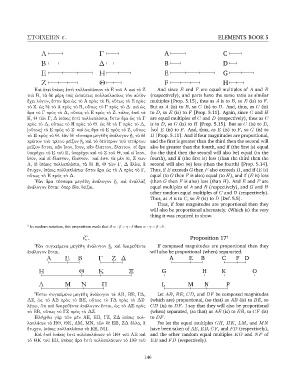
                    Α       Ε     Β       Γ     Ζ   ∆                   A       E    B        C     F D

                 Η                Θ       Κ            Ξ             G                H       K            O

                 Λ          Μ      Ν        Π                        L          M     N         P

               ῎Εστω συγκείμενα μεγέθη ἀνάλογον τὰ ΑΒ, ΒΕ, ΓΔ,     Let AB, BE, CD, and DF be composed magnitudes
            ΔΖ, ὡς τὸ ΑΒ πρὸς τὸ ΒΕ, οὕτως τὸ ΓΔ πρὸς τὸ ΔΖ· (which are) proportional, (so that) as AB (is) to BE, so
            λέγω, ὅτι καὶ διαιρεθέντα ἀνάλογον ἔσται, ὡς τὸ ΑΕ πρὸς  CD (is) to DF. I say that they will also be proportional
            τὸ ΕΒ, οὕτως τὸ ΓΖ πρὸς τὸ ΔΖ.                      (when) separated, (so that) as AE (is) to EB, so CF (is)
               Εἰλήφθω γὰρ τῶν μὲν ΑΕ, ΕΒ, ΓΖ, ΖΔ ἰσάκις πολ- to DF.
            λαπλάσια τὰ ΗΘ, ΘΚ, ΛΜ, ΜΝ, τῶν δὲ ΕΒ, ΖΔ ἄλλα, ἃ      For let the equal multiples GH, HK, LM, and MN
            ἔτυχεν, ἰσάκις πολλαπλάσια τὰ ΚΞ, ΝΠ.               have been taken of AE, EB, CF, and FD (respectively),
               Καὶ ἐπεὶ ἰσάκις ἐστὶ πολλαπλάσιον τὸ ΗΘ τοῦ ΑΕ καὶ and the other random equal multiples KO and NP of
            τὸ ΘΚ τοῦ ΕΒ, ἰσάκις ἄρα ἐστὶ πολλαπλάσιον τὸ ΗΘ τοῦ EB and FD (respectively).


                                                             146

