


Page 273 - D&D Bestiary
P. 273
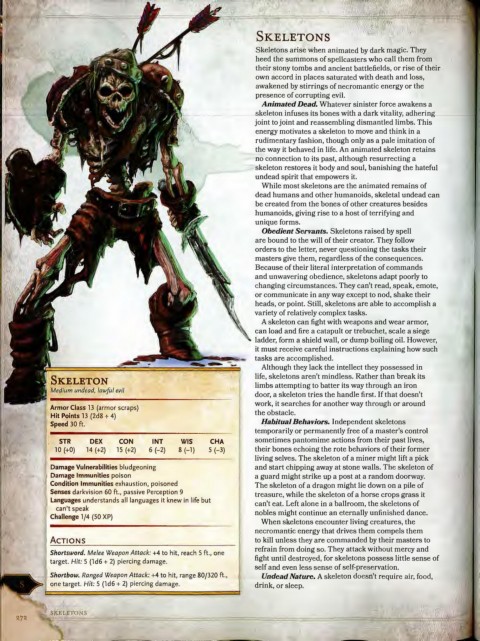
SKE:LIE.T:,ONS             . .   1,'

                                                               SReletons aris~ when animated by dark magic. They
                                                               heed the summons of spellcasters who call them from
                                                               their stony tombs and ancient battlefields, or rise of their
                                                               own accord in places saturated with death and loss,
                                                               awakened by stirrings of nycromantic energy or the
                                                               presence of corrupting evil.
                                                                 Animated Dead. Whatever sinister force awakens a
                                                               skeleton infuses its bones with a dark vitality, adhering
                                                               joint to joint and reassembling dismantled limbs. This
                                                               energy motivates a skeleton to move and think in a
                                                               rudimentary fashion, though only as a pale imitation of
                                                               the way it behaved in life. An animated skeleton retains
                                                               no connection to its past, although resurrecting a
                                                               skeleton restores it body and soul, banishing the hateful
                                                               undead spirit that empowers it.
                                                                 While most skeletons are the animated remains of
                                                               dead humans and other humanoids, skeletal undead can
                                                               be created from the bones of other creatures besides
                                                               humanoids, giving rise to a host of terrifying and
                                                               unique forms.
                                                                 Obedient Servants. Skeletons raised by spell
                                                               are bound to the will of their creator. They follow
                                                               orders to the letter, never questioning the tasks their
                                                               masters give them, regardless of the consequences.
                                                               Because of their literal interpretation of commands
                                                               and unwavering obedience, skeletons adapt poorly to
                                                               changing circumstances. They can't read, speak, emote,
                                                               or communicate in any way except to nod, shake their
                                                               heads, or point. Still, skeletons are able to accomplish a
                                                               variety of relatively complex tasks.
                                                                 A skeleton can fight with weapons and wear armor,
                                                               can load and fire a catapult or ttebuchet, scale a siege
                                                               ladder, form a shield wall, or dump boiling oil. However,
                                                               it must receive careful instructions explaining how such
                                                               tasks are accomplished.
                                                                 Although they lack the intellect they possessed in
                                                               life, skeletons aren't mindless. Rather than break its
                                                               limbs attempting to batter its way through an iron
             fi.lledium  undead, lawful evil
                                                               door, a skeleton tries the handle first. If that doesn't
                                                               work, it searches for another way through or around
           •  Armor Class 13  (armor scraps)
                                                               the obstacle.
             Hit Points 13  (2d8 + 4)
            · Speed 30 ft.                                      Habitual Behaviors. Independent skeletons
                                                               temporarily or permanently free of a master's control
               STR     DEX    CON     INT    WIS    CHA        sometimes pantomime actions from their past lives,
              10 (+0)   14 (+2)   15  (+2)   6 (-2)   8 (-1)   5 (-3)   their bones echoing the rote behaviors of their former
                                                               living selves. The skeleton of a miner might lift a pick
             Damage Vulnerabilities bludgeoning                and start chipping away at stone walls. The skeleton of
             Damage Immunities poison                          a guard might strike up a post at a random doorway.
             Condition Immunities exhaustion, poisoned         The skeleton of a dragon might lie down on a pile of
             Senses darkvision 60ft., passive Perception 9
                                                               treasure, while the skeleton of a horse crops grass it
             Languages understands all  languages it knew in  life  but
                                                               can't eat. Left alone in a ballroom, the skeletons of
               can't speak
             Challenge 1/4 (50 XP)                             nobles might continue an eternally unfinished dance.
                                                                When skeletons encounter living creatures, the
                                                               necromantic energy that drives them compels them
                                                               to kill unless they are commanded by their masters to
                                                               refrain from doing so. They attack without mercy and
             Shortsword.  Melee  Weapon Attack: +4 to hit,  reach 5 ft.,  one
                                                               fight until destroyed, for skeletons possess little sense of
             target. Hit:  5 (1d6 + 2)  piercing damage.
                                                               self and even less sense of self-preservation.
             Shortbow.  Ranged Weapon Attack: +4 to hit,  range 80f320 ft.,   Undead Nature. A skeleton doesn't require air, food,
             one target. Hit:  5 (1d6 + 2)  piercing damage.   drink, or sleep.

