


Page 122 - digitalliteracy
P. 122
6.2  Remaining Safe and Secure Online


                       Websites to Approach Cautiously


                       People who are looking to perpetrate a  scam—a
                       way to get money from another person by deceiving
                       them—or to inappropriately access someone’s per-
                       sonal information or engage in another illegal activ-
                       ity tend to be attracted to websites that have large
                       numbers of users and where personal information
                       is readily available. For this reason, you need to be
                       especially cautious when you access the following
                       types of sites, which are some of the most common
                       targets for fraud and criminal activity.
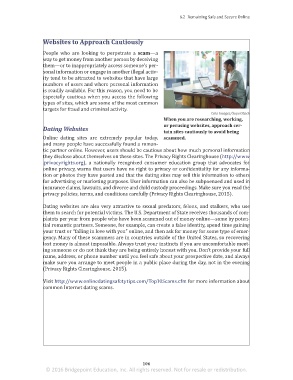
                                                                                             Caia Images/SuperStock
                                                                          When you are researching, working,
                                                                          or perusing websites, approach cer-
                       Dating Websites                                    tain sites cautiously to avoid being

                       Online dating sites are extremely popular today,  scammed.
                       and many people have successfully found a roman-
                       tic partner online. However, users should be cautious about how much personal information
                       they disclose about themselves on these sites. The Privacy Rights Clearinghouse (http://www
                       .privacyrights.org), a nationally recognized consumer education group that advocates for
                       online privacy, warns that users have no right to privacy or confidentiality for any informa-
                       tion or photos they have posted and that the dating sites may sell this information to others
                       for advertising or marketing purposes. User information can also be subpoenaed and used in
                       insurance claims, lawsuits, and divorce and child custody proceedings. Make sure you read the
                       privacy policies, terms, and conditions carefully (Privacy Rights Clearinghouse, 2015).

                       Dating websites are also very attractive to sexual predators, felons, and stalkers, who use
                       them to search for potential victims. The U.S. Department of State receives thousands of com-
                       plaints per year from people who have been scammed out of money online—some by poten-
                       tial romantic partners. Someone, for example, can create a false identity, spend time gaining
                       your trust or “falling in love with you” online, and then ask for money for some type of emer-
                       gency. Many of these scammers are in countries outside of the United States, so recovering
                       lost money is almost impossible. Always trust your instincts if you are uncomfortable meet-
                       ing someone or do not think they are being entirely honest with you. Don’t provide your full
                       name, address, or phone number until you feel safe about your prospective date, and always
                       make sure you arrange to meet people in a public place during the day, not in the evening
                       (Privacy Rights Clearinghouse, 2015).


                       Visit http://www.onlinedatingsafetytips.com/Top10Scams.cfm for more information about
                       common Internet dating scams.


                                                                 106
                        © 2016 Bridgepoint Education, Inc. All rights reserved. Not for resale or redistribution.


       sol82612_06_m06_097-120.indd   106                                                                            6/30/16   11:36 AM

