


Page 190 - digitalliteracy
P. 190
9.1  Responsible Borrowing


                       addition to being protected, the money you deposit in your savings account earns interest.
                       Think of that interest as rent on the money you put into the bank. After all, if the bank is going
                       to use your money to make loans, shouldn’t you be compensated for letting the bank use your
                       money? The bank makes money by paying you a smaller percentage than it charges its loan
                       customers. You might earn 0.5% on your savings, but a borrower on an auto loan would pay
                       2.4%, and the difference is the bank’s profit. That’s the beauty part, for both you and the bank.

                       Now, what about the beast of borrowing? When you borrow money from a lender, you agree
                       to pay back both the loan principal—the amount of the loan itself—and any interest that
                       has accrued over the loan term—the length or duration of the loan. Again, this interest is
                       effectively the rent you owe for being able to use someone else’s money. This is a scenario that
                       always benefits the lender, but it may be very costly to you depending on the loan you choose.

                       Let’s imagine that you are apartment hunting. Before signing any paperwork, you would come
                       to an agreement with the landlord about the length of the lease and the amount of rent you
                       pay. It’s unlikely that you would sign a 5-year lease for $1,500 per month when you only need
                       the apartment for a year and cannot afford to pay more than $800 in rent. Just as you wouldn’t
                       make this mistake with your housing, you can also avoid it when borrowing money.

                       Loans come in all shapes and sizes, and some options cost the borrower significantly more
                       money than others. The loan term and the way interest is calculated are the key variables in
                       any loan equation. We will explore various borrowing scenarios in the sections that follow.
                       For now, it is important to understand the difference between simple and compound inter-
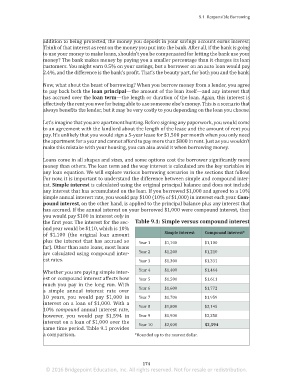
                       est. Simple interest is calculated using the original principal balance and does not include
                       any interest that has accumulated on the loan. If you borrowed $1,000 and agreed to a 10%
                       simple annual interest rate, you would pay $100 (10% of $1,000) in interest each year. Com-
                       pound interest, on the other hand, is applied to the principal balance plus any interest that
                       has accrued. If the annual interest on your borrowed $1,000 were compound interest, then
                       you would pay $100 in interest only in
                       the first year. The interest for the sec-  Table 9.1: Simple versus compound interest
                       ond year would be $110, which is 10%
                                                                          Simple interest  Compound interest*
                       of  $1,100  (the original loan amount
                       plus  the interest that  has accrued so
                                                               Year 1     $1,100           $1,100
                       far). Other than auto loans, most loans
                       are calculated using compound inter-    Year 2     $1,200           $1,210
                       est rates.                              Year 3     $1,300           $1,331

                                                               Year 4     $1,400           $1,464
                       Whether you are paying simple inter-
                       est or compound interest affects how    Year 5     $1,500           $1,611
                       much you pay in the long run. With
                                                               Year 6     $1,600           $1,772
                       a simple annual interest rate over
                       10  years, you would pay $1,000 in      Year 7     $1,700           $1,959
                       interest on a loan of $1,000. With a
                                                               Year 8     $1,800           $2,145
                       10% compound annual interest rate,
                       however, you would pay $1,594 in        Year 9     $1,900           $2,358
                       interest on a loan of $1,000 over the
                                                               Year 10    $2,000           $2,594
                       same time period. Table 9.1 provides
                       a comparison.                          *Rounded up to the nearest dollar.


                                                                 174
                        © 2016 Bridgepoint Education, Inc. All rights reserved. Not for resale or redistribution.


       sol82612_09_m09_171-194.indd   174                                                                            6/29/16   5:19 PM

