


Page 192 - digitalliteracy
P. 192
9.1  Responsible Borrowing


                       Student Loans: Know Your Options


                       College is an important investment for your educational, professional, and financial future. An
                       undergraduate degree makes you a more educated citizen, prepares you for a career, or helps
                       you move ahead in your current vocation. According to the National Center for Education Sta-
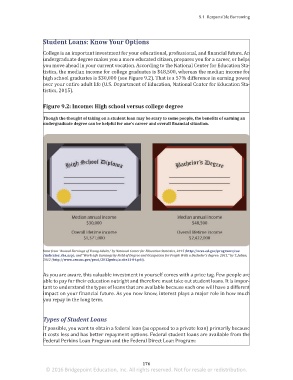
                       tistics, the median income for college graduates is $48,500, whereas the median income for
                       high school graduates is $30,000 (see Figure 9.2). That is a 57% difference in earning power
                       over your entire adult life (U.S. Department of Education, National Center for Education Sta-
                       tistics, 2015).

                       Figure 9.2: Income: High school versus college degree


                       Though the thought of taking on a student loan may be scary to some people, the benefits of earning an                                                                                        Creatas/Creatas/Thinkstock
                       undergraduate degree can be helpful for one’s career and overall financial situation.
                                                                                                                                                                                        There are several options for student loans, each
                                                                                                                                                                                        with different interest rates and repayment options.
                                                                                                                                                                                        Research all your options to determine which will
                                                                                                                                                                                        be best for you.


                       Data from “Annual Earnings of Young Adults,” by National Center for Education Statistics, 2015 (http://nces.ed.gov/programs/coe
                       /indicator_cba.asp); and “Work-Life Earnings by Field of Degree and Occupation for People With a Bachelor’s degree: 2011,” by T. Julian,
                       2012 (http://www.census.gov/prod/2012pubs/acsbr11-04.pdf).


                       As you are aware, this valuable investment in yourself comes with a price tag. Few people are
                       able to pay for their education outright and therefore must take out student loans. It is impor-
                       tant to understand the types of loans that are available because each one will have a different
                       impact on your financial future. As you now know, interest plays a major role in how much
                       you repay in the long term.


                       Types of Student Loans

                       If possible, you want to obtain a federal loan (as opposed to a private loan) primarily because
                       it costs less and has better repayment options. Federal student loans are available from the
                       Federal Perkins Loan Program and the Federal Direct Loan Program:


                                                                 176
                        © 2016 Bridgepoint Education, Inc. All rights reserved. Not for resale or redistribution.


       sol82612_09_m09_171-194.indd   176                                                                            6/29/16   5:19 PM

