


Page 121 - ArithBook5thEd ~ BCC
P. 121
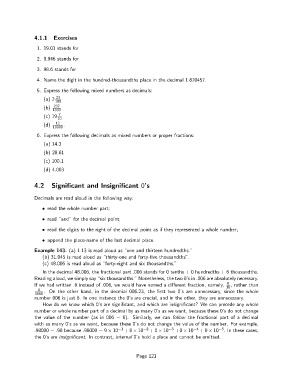
4.1.1   Exercises

                1. 19.01 stands for

                2. 0.946 stands for

                3. 98.6 stands for
                4. Name the digit in the hundred-thousandths place in the decimal 1.870457.

                5. Express the following mixed numbers as decimals:
                   (a) 2  23
                        100
                   (b)  237
                       1000
                          7
                   (c) 19 10
                        12
                   (d)  10000  .
                6. Express the following decimals as mixed numbers or proper fractions:
                   (a) 14.3
                   (b) 28.61
                   (c) 100.1

                   (d) 4.003


               4.2     Significant and Insignificant 0’s

               Decimals are read aloud in the following way:

                   • read the whole number part;
                   • read “and” for the decimal point;

                   • read the digits to the right of the decimal point as if they represented a whole number;

                   • append the place-name of the last decimal place.

               Example 143. (a) 1.13 is read aloud as “one and thirteen hundredths.”
                   (b) 31.045 is read aloud as “thirty-one and forty-five thousandths”.
                   (c) 48.006 is read aloud as “forty-eight and six thousandths.”
                   In the decimal 48.006, the fractional part .006 stands for 0 tenths + 0 hundredths + 6 thousandths.
               Reading aloud, we simply say “six thousandths.” Nonetheless, the two 0’s in .006 are absolutely necessary.
                                                                                                6
               If we had written .6 instead of .006, we would have named a different fraction, namely,  10 , rather than
                 6  . On the other hand, in the decmial 006.23, the first two 0’s are unnecessary, since the whole
                1000
               number 006 is just 6. In one instance the 0’s are crucial, and in the other, they are unnecessary.
                   How do we know which 0’s are significant, and which are insignificant? We can precede any whole
               number or whole number part of a decimal by as many 0’s as we want,because these 0’s do not change
               the value of the number (as in 006 = 6). Similarly, we can follow the fractional part of a decimal
               with as many 0’s as we want, because these 0’s do not change the value of the number. For example,
               .98000 = .98 because .98000 = 9 × 10 −1  +8 × 10 −2  +0 × 10 −3  +0 × 10 −4  +0 × 10 −5 .In these cases,
               the 0’s are insignificant. In contrast, internal 0’s hold a place and cannot be omitted.


                                                          Page 121

