


Page 122 - ArithBook5thEd ~ BCC
P. 122
3004
                                                                                                     304
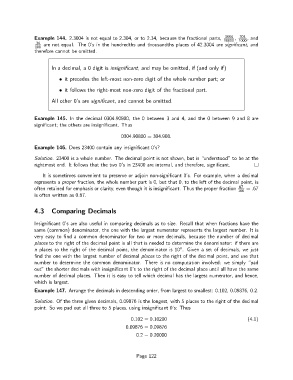
               Example 144. 2.3004 is not equal to 2.304, or to 2.34, because the fractional parts,  10000 ,  1000  ,and
                34  are not equal. The 0’s in the hundredths and thousandths places of 42.3004 are significant,and
                100
               therefore cannot be omitted.

                       In a decimal, a 0 digit is insignificant,andmay be omitted,if (and only if)

                          • it precedes the left-most non-zero digit of the whole number part; or

                          • it follows the right-most non-zero digit of the fractional part.

                       All other 0’s are significant,and cannot be omitted.


               Example 145. In the decimal 0304.90800, the 0 between 3 and 4, and the 0 between 9 and 8 are
               significant; the others are insignificant. Thus

                                                    0304.90800 = 304.908.

               Example 146. Does 23400 contain any insignificant 0’s?

               Solution. 23400 is a whole number. The decimal point is not shown, but is “understood” to be at the
               rightmost end. It follows that the two 0’s in 23400 are internal, and therefore, significant.

                   It is sometimes convenient to preserve or adjoin non-significant 0’s. For example, when a decimal
               represents a proper fraction, the whole number part is 0, but that 0, to the left of thedecimal point, is
               often retained for emphasis or clarity, even though it is insignificant. Thus the proper fraction  67  =.67
                                                                                                     100
               is often written as 0.67.


               4.3     Comparing Decimals


               Insignificant 0’s are also useful in comparing decimals as to size. Recall that when fractions have the
               same (common) denominator, the one with the largest numerator represents the largest number. It is
               very easy to find a common denominator for two or more decimals, because the number of decimal
               places to the right of the decimal point is all that is needed to determine the denominator: if there are
                                                                            n
               n places to the right of the decimal point, the denominator is 10 .Given a set of decimals, we just
               find the one with the largest number of decimal places to the right of the decimal point, and use that
               number to determine the common denominator. There is no computation involved: we simply “pad
               out” the shorter decimals with insignificant 0’s to the right of the decimal place until all have the same
               number of decimal places. Then it is easy to tell which decimal has the largest numerator, and hence,
               which is largest.
               Example 147. Arrange the decimals in descending order, from largest to smallest:0.102, 0.09876, 0.2.

               Solution. Of the three given decimals, 0.09876 is the longest, with 5 places to the right of the decimal
               point. So we pad out all three to 5 places, using insignificant 0’s: Thus
                                                        0.102 = 0.10200                                  (4.1)

                                                      0.09876 = 0.09876
                                                          0.2 = 0.20000


                                                          Page 122

