


Page 123 - ArithBook5thEd ~ BCC
P. 123
5
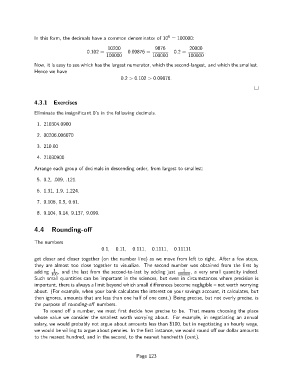
               In this form, the decimals have a common denominator of 10 =100000:
                                              10200               9876          20000
                                     0.102 =          0.09876 =           0.2 =       .
                                             100000              100000         100000
               Now, it is easy to see which has the largest numerator, which the second-largest, and which the smallest.
               Hence we have
                                                    0.2 > 0.102 > 0.09876.


               4.3.1   Exercises

               Eliminate the insignificant 0’s in the following decimals.

                1. 210304.0900

                2. 00206.006070

                3. 210.00
                4. 21030900

               Arrange each group of decimals in descending order, from largest to smallest:

                5. 0.2, .009, .121.

                6. 1.31, 1.9, 1.224.

                7. 0.106, 0.5, 0.61.

                8. 9.104, 9.14, 9.137, 9.099.


               4.4     Rounding-off

               The numbers
                                           0.1,  0.11,  0.111,   0.1111,  0.11111

               get closer and closer together (on the number line) as we move from left to right. After a few steps,
               they are almost too close together to visualize. The second number was obtained from the first by
               adding  1  , and the last from the second-to-last by adding just  1  , a very small quantity indeed.
                       100                                                 100000
               Such small quantities can be important in the sciences, but even in circumstances where precision is
               important, there is always a limit beyond which small differences become negligible – not worth worrying
               about. (For example, when your bank calculates the interest onyour savings account, it calculates, but
               then ignores, amounts that are less than one half of one cent.) Being precise, but not overly precise, is
               the purpose of rounding-off numbers.
                   To round off a number, we must first decide how precise to be. That means choosing the place
               whose value we consider the smallest worth worrying about. For example, in negotiating an annual
               salary, we would probably not argue about amounts less than $100, but in negotiating an hourly wage,
               we would be willing to argue about pennies. In the first instance, we would round off our dollar amounts
               to the nearest hundred, and in the second, to the nearest hundredth(cent).


                                                          Page 123

