


Page 124 - ArithBook5thEd ~ BCC
P. 124
Example 148. $175 is closer to $200 than to $100, so, rounding to the nearest hundred,we say that
               an annual salary of $36, 175 is approximately $36, 200. We write

                                           36175 ≈ 36200   (to the nearest hundred).

               The symbol ≈ means “approximately equal to.”
               Example 149. 16.84 is closer to 16.80 than to 16.90, so, to the nearest tenth,

                                                        16.84 ≈ 16.8.
               Notice that we dropped the insignificant 0 in 16.80.
               Example 150. 0.135 is exactly halfway between 0.130 and 0.140, so, if we want to round to the nearest
               hundredth, it is not clear whether we should round “up” to 0.140, or “down” to 0.130. Here, we have
               to make up a rule. The convention is that “halfway is almost home,” so we round up.

                                           0.135 ≈ 0.14  (to the nearest hundredth),

               where, again, we have dropped the insignificant 0 in 0.140.
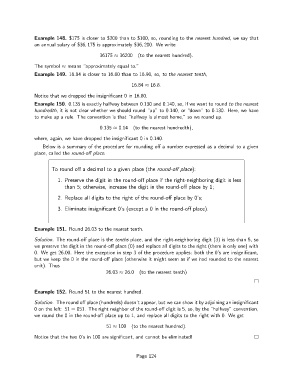
                   Below is a summary of the procedure for rounding off a number expressed as a decimal to a given
               place, called the round-off place.


                       To round off a decimal to a given place (the round-off place):

                         1. Preserve the digit in the round-off place if the right-neighboring digit is less
                            than 5; otherwise, increase the digit in the round-off place by1;

                         2. Replace all digits to the right of the round-off place by 0’s;

                         3. Eliminate insignificant 0’s (except a 0 in the round-off place).


               Example 151. Round 26.03 to the nearest tenth.

               Solution. The round-off place is the tenths place, and the right-neighboring digit (3) is less than 5, so
               we preserve the digit in the round-off place (0) and replace all digits to the right (there is only one) with
               0. We get 26.00. Here the exception in step 3 of the procedure applies: both the 0’s are insignificant,
               but we keep the 0 in the round-off place (otherwise it might seem as if we had rounded to the nearest
               unit). Thus
                                             26.03 ≈ 26.0  (to the nearest tenth)


               Example 152. Round 51 to the nearest hundred.

               Solution. The round off place (hundreds) doesn’t appear, but we can show it byadjoining aninsignificant
               0 on the left: 51 = 051. The right neighbor of the round-off digit is5, so, by the “halfway” convention,
               we round the 0 in the round-off place up to 1, and replace all digits to the right with 0. We get
                                             51 ≈ 100   (to the nearest hundred).

               Notice that the two 0’s in 100 are significant, and cannot be eliminated!


                                                          Page 124

