


Page 21 - ArithBook5thEd ~ BCC
P. 21
1.3.1   Commutativity, Associativity, Identity, the Zero Property

               An examination of the multiplication table leads us to an important property of 0, namely, when any
               number, N, is multiplied by 0, the product is 0:

                                                      0 · N = N · 0= 0.

               It also shows us an important property of 1, namely, when any number, N,is multiplied by 1,the
               product is the identical number, x,again:

                                                      1 · N = N · 1= N.

               For this reason, 1 is called the multiplicative identity.
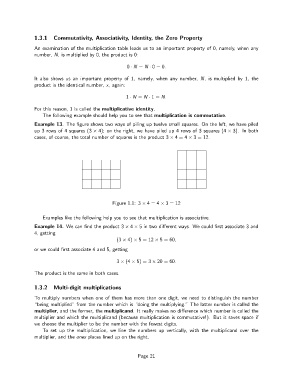
                   The following example should help you to see that multiplication is commutative.
               Example 13. The figure shows two ways of piling up twelve small squares. On theleft, we havepiled
               up 3 rows of 4 squares (3 × 4); on the right, we have piled up 4 rows of 3 squares (4 × 3). In both
               cases, of course, the total number of squares is the product 3 × 4= 4 × 3= 12.


                                                Figure 1.1: 3 × 4= 4 × 3= 12


                   Examples like the following help you to see that multiplication is associative.
               Example 14. We can find the product 3 × 4 × 5 in two different ways. We could first associate 3 and
               4, getting
                                                  (3 × 4) × 5= 12 × 5= 60,
               or we could first associate 4 and 5, getting


                                                  3 × (4 × 5) = 3 × 20 = 60.

               The product is the same in both cases.

               1.3.2   Multi-digit multiplications

               To multiply numbers when one of them has more than one digit, we need to distinguish the number
               “being multiplied” from the number which is “doing the multiplying.” The latter number is called the
               multiplier, and the former, the multiplicand. It really makes no difference which number is called the
               multiplier and which the multiplicand (because multiplication is commutative!). But it saves space if
               we choose the multiplier to be the number with the fewest digits.
                   To set up the multiplication, we line the numbers up vertically,with the multiplicand over the
               multiplier, and the ones places lined up on the right.


                                                           Page 21

