


Page 23 - ArithBook5thEd ~ BCC
P. 23
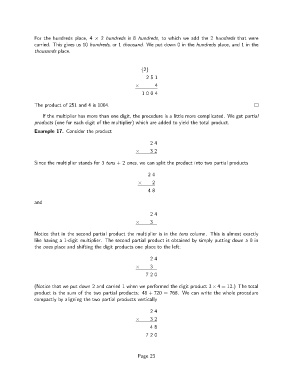
For the hundreds place, 4 × 2 hundreds is 8 hundreds,to which we add the 2 hundreds that were
               carried. This gives us 10 hundreds,or 1 thousand.We put down 0 in the hundreds place, and 1 in the
               thousands place.


                                                            {2}
                                                              251
                                                          ×       4
                                                            10 0 4

               The product of 251 and 4 is 1004.

                   If the multiplier has more than one digit, the procedure is a little more complicated. We get partial
               products (one for each digit of the multiplier) which are added to yield the total product.

               Example 17. Consider the product

                                                                24
                                                          ×     32

               Since the multiplier stands for 3 tens +2 ones, we can split the product into two partial products

                                                               24
                                                           ×     2
                                                               48

               and

                                                                24

                                                          ×     3
               Notice that in the second partial product the multiplier is in the tens column. This is almost exactly
               like having a 1-digit multiplier. The second partial product is obtained by simply putting down a 0 in
               the ones place and shifting the digit products one place to the left:

                                                                24
                                                          ×     3
                                                              72 0

               (Notice that we put down 2 and carried 1 when we performed the digit product 3 × 4= 12.) The total
               product is the sum of the two partial products: 48 + 720 = 768. We can write the whole procedure
               compactly by aligning the two partial products vertically

                                                                24

                                                          ×     32
                                                                48
                                                              72 0


                                                           Page 23

