


Page 24 - ArithBook5thEd ~ BCC
P. 24
and then performing the addition


                                                                 24
                                                           ×     32
                                                                 48
                                                         +     7 2 0
                                                               76 8

                   Here’s another example.

               Example 18. Find the product of 29 and 135.

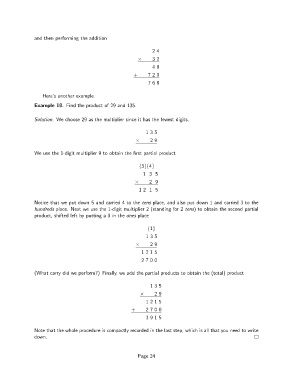
               Solution. We choose 29 as the multiplier since it has the fewest digits.


                                                              13 5
                                                          ×     29

               We use the 1-digit multiplier 9 to obtain the first partial product


                                                           {3}{4}
                                                             13 5
                                                         ×     29
                                                           12 1 5

               Notice that we put down 5 and carried 4 to the tens place, and also put down 1 and carried 3 to the
               hundreds place. Next we use the 1-digit multiplier 2 (standing for 2 tens) to obtain the second partial
               product, shifted left by putting a 0 in the ones place

                                                               {1}
                                                              13 5

                                                          ×     29
                                                            121 5
                                                            270 0

               (What carry did we perform?) Finally, we add the partial products to obtain the (total) product


                                                                13 5
                                                            ×     29
                                                              12 15
                                                        +     2 7 0 0
                                                              39 15


               Note that the whole procedure is compactly recorded in the last step, which is all that you need to write
               down.


                                                           Page 24

