


Page 46 - ArithBook5thEd ~ BCC
P. 46
make up the difference. So its length must be

                                                      6 − (1 + 3) = 2 ft.

               The other missing side (the short horizontal one) is 2 ft. Adding up all the side lengths, starting
               (arbitrarily) with the bottom edge and proceeding counter-clockwise, yields the perimeter:

                                             5+ 1 + 2+ 3+ 2+ 2+ 5 + 6 = 26 ft.


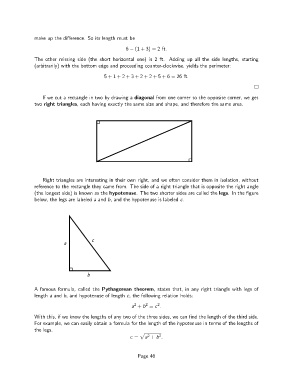
                   If we cut a rectangle in two by drawing a diagonal from one corner to the opposite corner, we get
               two right triangles, each having exactly the same size and shape, and therefore the same area.


                   Right triangles are interesting in their own right, and we often consider them in isolation, without
               reference to the rectangle they came from. The side of a right triangle that is opposite the right angle
               (the longest side) is known as the hypotenuse. The two shorter sides are called the legs. In the figure
               below, the legs are labeled a and b,and the hypotenuse is labeled c.


                                       c
                            a


                                     b


               A famous formula, called the Pythagorean theorem, states that, in any right triangle with legs of
               length a and b,and hypotenuse of length c, the following relation holds:

                                                         2
                                                              2
                                                                   2
                                                        a + b = c .
               With this, if we know the lengths of any two of the three sides, we can find the length of the third side.
               For example, we can easily obtain a formula for the length of the hypotenuse in terms of the lengths of
               the legs.
                                                           !
                                                       c =    a + b .
                                                                   2
                                                               2
                                                           Page 46

