


Page 48 - ArithBook5thEd ~ BCC
P. 48
2
               The rectangle has length 6 cm and width 2 cm, so it has area 6 · 2= 12 cm . Both triangles have legs
                                                                    2
               of length 1 and 2, so the area of each is (2 · 1) ÷ 2= 1 cm . Adding the three areas gives the total area
                                                 2
               of the polygon: 1 + 12 + 1 = 14 cm . To find the perimeter, we use the Pythagorean theorem to find
               the lengths of the two slanted sides:
                                                                          √
                                                   !           !
                                                           2
                                                      2
                                                                  2
                                                                      2
                                               c =   a + b =     1 +2 =     5.
               Thus the perimeter is
                                              √         √              √
                                                5+ 7+    5+ 7 = 14+ 2 5cm.
                     √
               Since   5 is not an integer, we do not simplify the expression further. But we can make the following
                              √                       √
               estimate: Since  5is between 2and 3, 2 5 is between 4 and 6, and it follows that the perimeter is
               between 18 and 20 centimeters.
               1.9.1   Exercises

                1. Find the area of a right triangle whose legs are 5 in and 12 in.
                2. Find the perimeter of the right triangle in the previous example.

                3. Find the area of a rectangle whose length is 8 ft and whose widthis 7 feet.

                4. Find the perimeter of the rectangle in the previous example.

                5. Find the length of the diagonal of a square which is 2 cm on a side. Between what two whole
                   numbers does the answer lie?
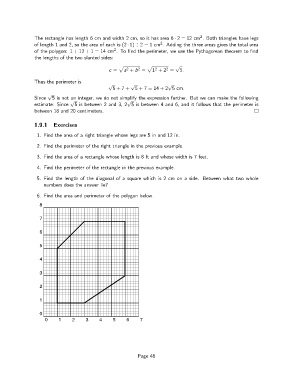
                6. Find the area and perimeter of the polygon below.

                  8

                  7


                  6

                  5


                  4

                  3


                  2


                  1

                  0
                    0     1    2     3     4    5     6     7


                                                           Page 48

