


Page 55 - ArithBook5thEd ~ BCC
P. 55
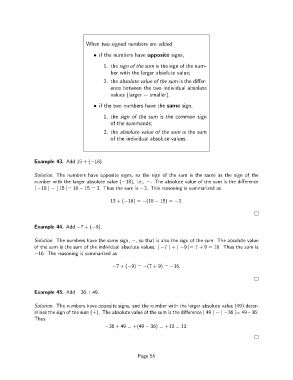
When two signed numbers are added

                                        • if the numbers have opposite signs,
                                            1. the sign of the sum is the sign of the num-
                                               ber with the larger absolute value;
                                            2. the absolute value of the sum is the differ-
                                               ence between the two individual absolute
                                               values (larger − smaller).

                                        • if the two numbers have the same sign,

                                            1. the sign of the sum is the common sign
                                               of the summands;
                                            2. the absolute value of the sum is the sum
                                               of the individual absolute values.


               Example 43. Add 15 + (−18).

               Solution. The numbers have opposite signs, so the sign of the sum is the same as the sign of the
               number with the larger absolute value (−18), i.e., −. The absolute value of the sum is the difference
               | −18 | − | 15 |=18 − 15 = 3. Thus the sum is −3. This reasoning is summarized as


                                               15 + (−18) = −(18 − 15) = −3.


               Example 44. Add −7+ (−9).


               Solution. The numbers have the same sign, −,so that is also the sign of the sum. The absolute value
               of the sum is the sum of the individual absolute values, | −7 | + | −9 |=7 + 9 =16. Thus the sum is
               −16. The reasoning is summarized as

                                                −7+ (−9) = −(7 + 9) = −16.


               Example 45. Add −36 + 49.

               Solution. The numbers have opposite signs, and the number with the larger absolute value (49) deter-
               mines the sign of the sum (+). The absolute value of the sum is the difference | 49 | − | −36 |=49−36.
               Thus
                                             −36 + 49 = +(49 − 36) = +13 = 13.


                                                           Page 55

