


Page 54 - ArithBook5thEd ~ BCC
P. 54
As the picture shows, we end up at −1. We conclude that 2 + (−3) = −1.


                   When two signed numbers are added, the order of addition does not affect the sum.


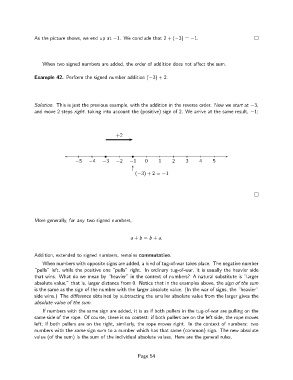
               Example 42. Perform the signed number addition (−3) + 2.


               Solution. This is just the previous example, with the addition in the reverse order. Now we start at −3,
               and move 2 steps right, taking into account the (positive) sign of 2. We arrive at the same result, −1:


                                                 +2


                                  |    |           |          |     |    |     |     |    |
                                −5    −4    −3   −2    −1     0    1     2     3    4     5


                                                          (−3) + 2 = −1


               More generally, for any two signed numbers,


                                                        a + b = b + a.


               Addition, extended to signed numbers, remains commutative.
                   When numbers with opposite signs are added, a kind of tug-of-wartakes place. The negative number
               “pulls” left, while the positive one “pulls” right. In ordinary tug-of-war, it is usually the heavier side
               that wins. What do we mean by “heavier” in the context of numbers? A natural substitute is “larger
               absolute value,” that is, larger distance from 0. Notice that inthe examples above, the sign of the sum
               is the same as the sign of the number with the larger absolute value. (In the war of signs, the “heavier”
               side wins.) The difference obtained by subtracting the smaller absolute value from the larger gives the
               absolute value of the sum.
                   If numbers with the same sign are added, it is as if both pullers in the tug-of-war are pulling on the
               same side of the rope. Of course, there is no contest: if both pullers are on the left side, the rope moves
               left; if both pullers are on the right, similarly, the rope moves right. In the context of numbers: two
               numbers with the same sign sum to a number which has that same (common) sign. The new absolute
               value (of the sum) is the sum of the individual absolute values. Here are the general rules.


                                                           Page 54

