


Page 9 - ArithBook5thEd ~ BCC
P. 9
Chapter 1


               Whole numbers


               The natural numbers are the counting numbers: 1, 2, 3, 4, 5, 6, ... . The dots indicate that the sequence
               is infinite – counting can go on forever, since you can always get the next number by simply adding 1
               to the previous number. In order to write numbers efficiently, and for other reasons, we also need the
               number 0. Later on, we will need the sequence of negative numbers −1, −2, −3, −4, −5, −6, ... . Taken
               together, all these numbers are called the integers.
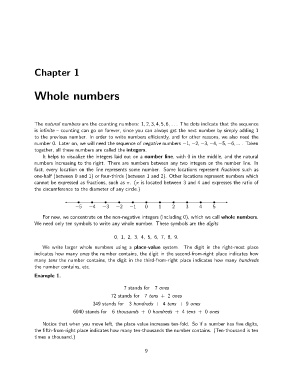
                   It helps to visualize the integers laid out on a number line, with 0 in the middle, and the natural
               numbers increasing to the right. There are numbers between any two integers on the number line. In
               fact, every location on the line represents some number. Some locations represent fractions such as
               one-half (between 0 and 1) or four-thirds (between 1 and 2). Other locations represent numbers which
               cannot be expressed as fractions, such as π.(π is located between 3 and 4 and expresses the ratio of
               the circumference to the diameter of any circle.)


                                −5    −4    −3   −2    −1     0    1     2     3    4     5

                   For now, we concentrate on the non-negative integers (including 0), which we call whole numbers.
               We need only ten symbols to write any whole number. These symbols are the digits

                                                 0, 1, 2, 3, 4, 5, 6, 7, 8, 9.

                   We write larger whole numbers using a place-value system. The digit in the right-most place
               indicates how many ones the number contains, the digit in the second-from-right place indicates how
               many tens the number contains, the digit in the third-from-right place indicates how many hundreds
               the number contains, etc.
               Example 1.

                                                     7stands for  7 ones
                                               72 stands for  7 tens +2 ones
                                        349 stands for  3 hundreds +4 tens +9 ones

                                6040 stands for  6 thousands +0 hundreds +4 tens +0 ones

                   Notice that when you move left, the place value increases ten-fold. So if a number has five digits,
               the fifth-from-right place indicates how many ten-thousands the number contains. (Ten-thousand is ten
               times a thousand.)


                                                              9

