


Page 98 - ArithBook5thEd ~ BCC
P. 98
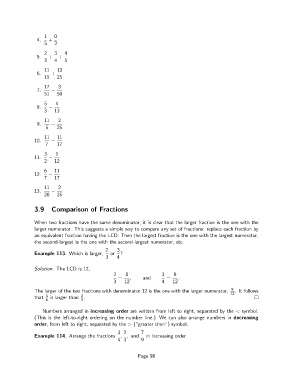
1   0
                4.   +
                    5   2
                    2   3   4
                5.   +    +
                    3   4   5

                    11   13
                6.    +
                    15   25
                    17   3
                7.    −
                    51   50
                    5   4
                8.   −
                    3   13

                    11   2
                9.    −
                    5    25
                    11   11
               10.    −
                    7    17

                    3   1
               11.   −
                    2   12
                    6   11
               12.   −
                    7   17
                    11   2
               13.    −
                    20   25


               3.9     Comparison of Fractions

               When two fractions have the same denominator, it is clear that the larger fraction is the one with the
               larger numerator. This suggests a simple way to compare any set of fractions: replace each fraction by
               an equivalent fraction having the LCD. Then the largest fraction is the one with the largest numerator,
               the second-largest is the one with the second-largest numerator, etc.
                                             2    3
               Example 113. Which is larger,   or  ?
                                             3    4
               Solution. The LCD is 12,
                                                2     8              3    9
                                                  =    ,     and       =    .
                                                3    12              4   12
                                                                                                  9
               The larger of the two fractions with denominator 12 is the one with the larger numerator,  12 .It follows
                                   2
               that  3  is larger than .
                    4              3
                   Numbers arranged in increasing order are written from left to right, separated by the < symbol.
               (This is the left-to-right ordering on the number line.) We can also arrange numbers in decreasing
               order, from left to right, separated by the > (“greater than”) symbol.
                                                  3 2       7
               Example 114. Arrange the fractions  , ,and     in increasing order.
                                                  4 3       9


                                                           Page 98

