


Page 97 - ArithBook5thEd ~ BCC
P. 97
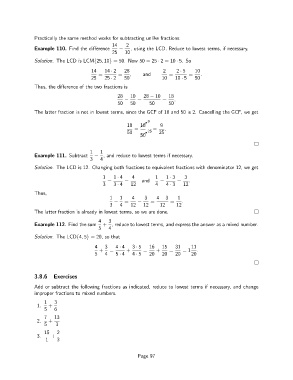
Practically the same method works for subtracting unlike fractions.
                                                14    2
               Example 110. Find the difference     −    , using the LCD. Reduce to lowest terms, if necessary.
                                                25   10
               Solution. The LCD is LCM{25, 10} =50. Now 50 =25 · 2= 10 · 5. So

                                       14    14 · 2  28              2     2 · 5  10
                                          =       =    ,     and        =       =    .
                                       25    25 · 2  50              10   10 · 5  50
               Thus, the difference of the two fractions is
                                                  28   10    28 − 10   18
                                                     −     =         =    .
                                                  50   50      50      50
               The latter fraction is not in lowest terms, since the GCF of 18 and50 is 2. Cancelling the GCF, we get
                                                             ✚❃
                                                      18    ✚ 18  9  9
                                                         =       =    .
                                                      50     ✚❃ 25  25
                                                            ✚ 50


                                       1   1
               Example 111. Subtract    − , and reduce to lowest terms if necessary.
                                       3   4
               Solution. The LCD is 12. Changing both fractions to equivalent fractions with denominator 12, we get

                                            1   1 · 4   4         1   1 · 3   3
                                              =      =      and     =      =    .
                                            3   3 · 4   12        4   4 · 3   12
               Thus,
                                               1   1    4    3    4 − 3    1
                                                 −   =     −    =       =    .
                                               3   4    12   12     12     12
               The latter fraction is already in lowest terms, so we are done.
                                          4   3
               Example 112. Find the sum    + , reduce to lowest terms, and express the answer as a mixed number.
                                          5   4
               Solution. The LCD{4, 5} =20, so that

                                         4   3   4 · 4  3 · 5  16    15   31     11
                                          +    =      +      =    +     =    =1    .
                                         5   4   5 · 4  4 · 5  20    20   20     20


               3.8.6   Exercises
               Add or subtract the following fractions as indicated, reduce to lowest terms if necessary, and change
               improper fractions to mixed numbers.
                    1   3
                1.   +
                    5   6
                    7   13
                2.   +
                    5   3
                    15   2
                3.    +
                    1    3


                                                           Page 97

