


Page 96 - ArithBook5thEd ~ BCC
P. 96
7. LCM{51, 34, 17}
                8. LCM{15, 12}

                9. LCM{18, 8}

               10. LCM{3, 4, 5}

               11. LCM{4, 14}
               12. LCM{2, 5, 9}
                          2
                                          2
                                      4
                              2
               13. LCM{3 · 5 · 11,   3 · 7 }
               3.8.5   The LCD
               To add unlike fractions so that the sum is in lowest terms, we use the LCM of their denominators. This
               is such a useful number that it has a special name: the LCD or Least Common Denominator.
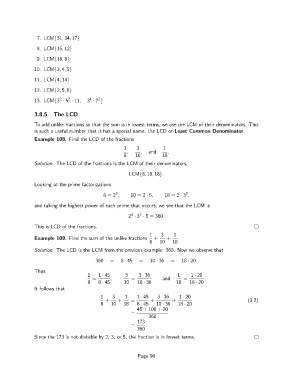
               Example 108. Find the LCD of the fractions
                                                     1    3          1
                                                      ,     ,  and     .
                                                     8    10         18
               Solution. The LCD of the fractions is the LCM of their denominators,

                                                       LCM{8, 10, 18}.

               Looking at the prime factorizations
                                                 3
                                                                               2
                                            8= 2 ,      10 = 2 · 5,   18 = 2 · 3 ,
               and taking the highest power of each prime that occurs, we see that the LCM is
                                                        3
                                                           2
                                                       2 · 3 · 5= 360.
               This is LCD of the fractions.
                                                                1   3     1
               Example 109. Find the sum of the unlike fractions  +    +    .
                                                                8   10   18
               Solution. The LCD is the LCM from the previous example: 360. Now we observe that

                                         360   =    8 · 45  =   10 · 36  =   18 · 20.

               Thus
                                      1   1 · 45     3     3 · 36          1     1 · 20
                                        =      ,        =            and      =       .
                                      8   8 · 45     10   10 · 36          18   18 · 20
               It follows that
                                           1    3    1    1 · 45   3 · 36   1 · 20
                                             +    +     =       +        +                               (3.2)
                                           8   10    18   8 · 45  10 · 36  18 · 20
                                                          45 + 108 + 20
                                                        =
                                                               360
                                                          173
                                                        =     .
                                                          360
               Since the 173 is not divisible by 2, 3, or 5, the fraction is in lowest terms.


                                                           Page 96

