


Page 134 - text book form physics kssm 2020
P. 134
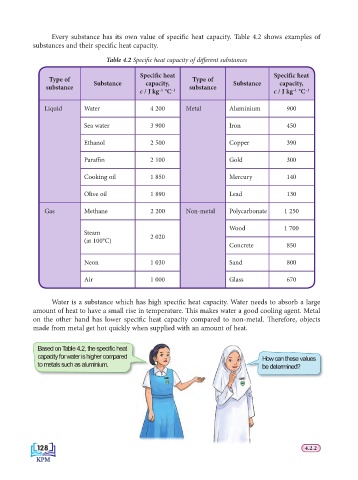
Every substance has its own value of specifi c heat capacity. Table 4.2 shows examples of
                 substances and their specifi c heat capacity.
                                       Table 4.2 Specifi c heat capacity of diff erent substances

                                                 Specifi c heat                          Specifi c heat
                      Type of                                    Type of
                                   Substance       capacity,                 Substance     capacity,
                     substance                                  substance
                                                       –1
                                                                                               –1
                                                 c / J kg  °C –1                         c / J kg  °C –1
                    Liquid      Water               4 200      Metal        Aluminium        900

                                Sea water           3 900                   Iron             450

                                Ethanol             2 500                   Copper           390

                                Paraffi  n          2 100                   Gold             300

                                Cooking oil         1 850                   Mercury          140

                                Olive oil           1 890                   Lead             130


                    Gas         Methane             2 200      Non-metal    Polycarbonate   1 250

                                                                            Wood            1 700
                                Steam
                                                    2 020
                                (at 100°C)
                                                                            Concrete         850
                                Neon                1 030                   Sand             800


                                Air                 1 000                   Glass            670


                      Water is a substance which has high specifi c heat capacity. Water needs to absorb a large
                 amount of heat to have a small rise in temperature. Th  is makes water a good cooling agent. Metal
                 on the other hand has lower specifi c heat capacity compared to non-metal. Th erefore,  objects
                 made from metal get hot quickly when supplied with an amount of heat.


                  Based on Table 4.2, the specifi c heat
                  capacity for water is higher compared                               How can these values
                  to metals such as aluminium.                                        be determined?


                  128
                  128                                                                             4.2.2
                                                                                                  4.2.2

