


Page 189 - text book form physics kssm 2020
P. 189
Chapter 5
                                                                                                   Waves
                           Activity 5.7

                   Aim: To determine the wavelength, frequency and wave speed
                   Apparatus: Ripple tank and its accessories, digital xenon stroboscope and ruler
                   Materials: Distilled water
                                                                                   Plane dipper er
                   Instructions:                                                   Plane dipp
                                                                                            D
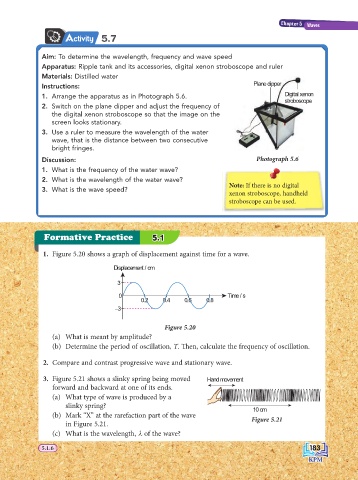
                   1.  Arrange the apparatus as in Photograph 5.6.                          Digital xenonigital xe
                                                                                            stroboscopeo
                                                                                            strobosc
                   2.  Switch on the plane dipper and adjust the frequency of
                      the digital xenon stroboscope so that the image on the
                      screen looks stationary.
                   3.  Use a ruler to measure the wavelength of the water
                      wave, that is the distance between two consecutive
                      bright fringes.

                   Discussion:                                                      Photograph 5.6
                   1.  What is the frequency of the water wave?
                   2.  What is the wavelength of the water wave?
                   3.  What is the wave speed?                              Note: If there is no digital
                                                                            xenon stroboscope, handheld
                                                                            stroboscope can be used.


                    Formative Practice               5.1
                                                     5.1

                    1.  Figure 5.20 shows a graph of displacement against time for a wave.
                                         Displacement / cm

                                          3
                                          0                                Time / s
                                                 0.2    0.4   0.6    0.8
                                         –3


                                                        Figure 5.20
                       (a)  What is meant by amplitude?
                       (b)  Determine the period of oscillation, T. Th  en, calculate the frequency of oscillation.

                    2.  Compare and contrast progressive wave and stationary wave.

                    3.  Figure 5.21 shows a slinky spring being moved   Hand movement
                       forward and backward at one of its ends.
                       (a)  What type of wave is produced by a
                          slinky spring?
                                                                                   10 cm
                       (b)  Mark “X” at the rarefaction part of the wave
                          in Figure 5.21.                                         Figure 5.21
                       (c)  What is the wavelength, λ of the wave?

                                                                                                    183
                                                                                                    183
                                                                                                    183
                   5.1.6
                   5.1.6                                                                            183

