


Page 191 - text book form physics kssm 2020
P. 191
Chapter 5
                                                                                                   Waves
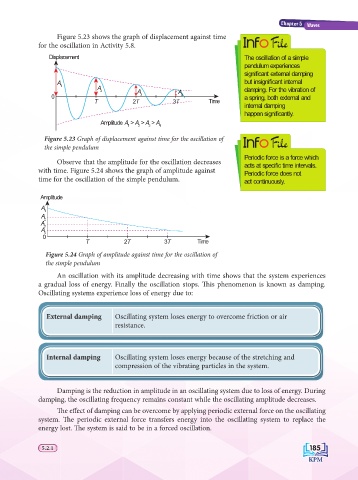
                        Figure 5.23 shows the graph of displacement against time        File
                  for the oscillation in Activity 5.8.
                      Displacement                                              The oscillation of a simple
                                                                                pendulum experiences
                                                                                signifi cant external damping
                        A                                                       but insignifi cant internal
                         1          A
                                     2          A           A                   damping. For the vibration of
                      0                          3           4                  a spring, both external and
                                   T           2T          3T         Time
                                                                                internal damping
                                                                                happen signifi cantly.
                                     Amplitude A  > A  > A  > A
                                             1  2  3   4
                    Figure 5.23 Graph of displacement against time for the oscillation of   File
                    the simple pendulum
                                                                                Periodic force is a force which
                        Observe that the amplitude for the oscillation decreases   acts at specifi c time intervals.
                  with time. Figure 5.24 shows the graph of amplitude against   Periodic force does not
                  time for the oscillation of the simple pendulum.              act continuously.

                   Amplitude
                   A
                    1
                   A 2
                   A 3
                   A 4
                    0
                                T           2T          3T        Time

                     Figure 5.24 Graph of amplitude against time for the oscillation of
                     the simple pendulum

                        An oscillation with its amplitude decreasing with time shows that the system experiences
                  a gradual loss of energy. Finally the oscillation stops. Th  is phenomenon is known as damping.
                  Oscillating systems experience loss of energy due to:


                     External damping    Oscillating system loses energy to overcome friction or air
                                         resistance.


                     Internal damping    Oscillating system loses energy because of the stretching and
                                         compression of the vibrating particles in the system.


                        Damping is the reduction in amplitude in an oscillating system due to loss of energy. During
                  damping, the oscillating frequency remains constant while the oscillating amplitude decreases.
                        Th e eff ect of damping can be overcome by applying periodic external force on the oscillating
                  system. Th  e periodic external force transfers energy into the oscillating system to replace the
                  energy lost. Th  e system is said to be in a forced oscillation.


                                                                                                    185
                                                                                                    185
                                                                                                    185
                   5.2.1                                                                            185
                   5.2.1

