


Page 192 - text book form physics kssm 2020
P. 192
When a periodic force is applied to an oscillating system at its natural frequency, the
                 oscillating system is said to be at resonance.

                                   During resonance:
                                   •  System oscillates with its natural frequency.
                                   •  System oscillates with maximum amplitude.


                         Activity 5.9


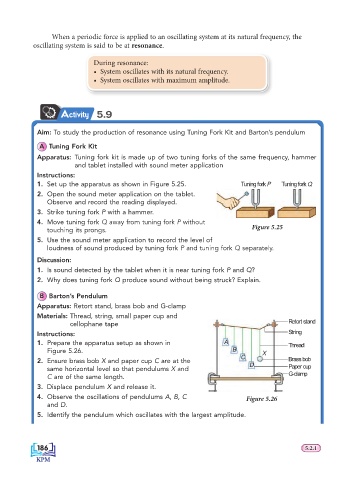
                  Aim: To study the production of resonance using Tuning Fork Kit and Barton’s pendulum
                   A  Tuning Fork Kit
                  Apparatus:  Tuning fork kit is made up of two tuning forks of the same frequency, hammer
                             and tablet installed with sound meter application
                  Instructions:
                  1.  Set up the apparatus as shown in Figure 5.25.            Tuning fork P  Tuning fork Q
                  2.  Open the sound meter application on the tablet.
                     Observe and record the reading displayed.
                  3.  Strike tuning fork P with a hammer.
                  4.  Move tuning fork Q away from tuning fork P without
                     touching its prongs.                                          Figure 5.25
                  5.  Use the sound meter application to record the level of
                     loudness of sound produced by tuning fork P and tuning fork Q separately.

                  Discussion:
                  1.  Is sound detected by the tablet when it is near tuning fork P and Q?
                  2.  Why does tuning fork Q produce sound without being struck? Explain.

                   B  Barton’s Pendulum
                  Apparatus: Retort stand, brass bob and G-clamp
                  Materials:  Thread, string, small paper cup and
                            cellophane tape                                                   Retort stand
                  Instructions:                                                               String
                  1.  Prepare the apparatus setup as shown in             A                   Thread
                     Figure 5.26.                                            B        X
                  2.  Ensure brass bob X and paper cup C are at the            C  D           Brass bob
                     same horizontal level so that pendulums X and                            Paper cup
                     C are of the same length.                                                G-clamp
                  3.  Displace pendulum X and release it.
                  4.  Observe the oscillations of pendulums A, B, C
                     and D.                                                      Figure 5.26
                  5.  Identify the pendulum which oscillates with the largest amplitude.


                  186                                                                              5.2.1
                  186
                  186
                  186
                                                                                                   5.2.1

