


Page 53 - text book form physics kssm 2020
P. 53
Chapter 2  Force and Motion I

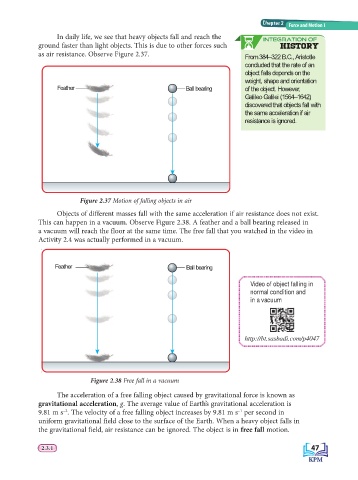
                        In daily life, we see that heavy objects fall and reach the   INTEGRATION OF
                  ground faster than light objects. This is due to other forces such       HISTORY
                  as air resistance. Observe Figure 2.37.                       From 384–322 B.C., Aristotle
                                                                                concluded that the rate of an
                                                                                object falls depends on the
                                                                                weight, shape and orientation
                        Feather                                Ball bearing     of the object. However,
                                                                                Galileo Galilei (1564–1642)
                                                                                discovered that objects fall with
                                                                                the same acceleration if air
                                                                                resistance is ignored.


                               Figure 2.37 Motion of falling objects in air
                        Objects of different masses fall with the same acceleration if air resistance does not exist.
                  This can happen in a vacuum. Observe Figure 2.38. A feather and a ball bearing released in
                  a vacuum will reach the floor at the same time. The free fall that you watched in the video in
                  Activity 2.4 was actually performed in a vacuum.


                       Feather                                 Ball bearing

                                                                                  Video of object falling in
                                                                                  normal condition and
                                                                                  in a vacuum


                                                                                http://bt.sasbadi.com/p4047


                                  Figure 2.38 Free fall in a vacuum

                        The acceleration of a free falling object caused by gravitational force is known as
                  gravitational acceleration, g. The average value of Earth’s gravitational acceleration is
                  9.81 m s . The velocity of a free falling object increases by 9.81 m s  per second in
                          –2
                                                                              –1
                  uniform gravitational field close to the surface of the Earth. When a heavy object falls in
                  the gravitational field, air resistance can be ignored. The object is in free fall motion.

                                                                                                    47
                   2.3.1
                   2.3.1                                                                            47

