


Page 55 - text book form physics kssm 2020
P. 55
Chapter 2  Force and Motion I

                    Results:

                                                          Table 2.6
                                                 Time when the steel ball passes
                        Distance between two          through photogates             Gravitational
                         photogates, h / cm                                       acceleration, g / m s –2
                                                    t  / s           t  / s
                                                     1                2
                               30.0
                               40.0
                               50.0

                               60.0
                               70.0

                    Analysis of data:
                    1.  Determine the value of g using the formula g =   2h  .
                                                                  t  – t 1 2
                                                                    2
                                                                   2
                    2.  Calculate the average value of g.
                    Conclusion:
                    What conclusion can be made from this experiment?

                    Prepare a complete report on this experiment.
                    Discussion:
                    1.  Compare the average value of g from this experiment with the standard value of g at the
                       equator, 9.78 m s . Why are these two values different?
                                      –2
                    2.  Explain one precaution to improve the accuracy of the results in this experiment.


                        The value of gravitational acceleration, g changes from one place to another. For example,
                                                     –2
                                                                                                    –2
                  the value of g at the equator is 9.78 m s  while the value of g at the Earth’s poles is 9.83 m s .
                  This is because Earth is actually not a perfect sphere.
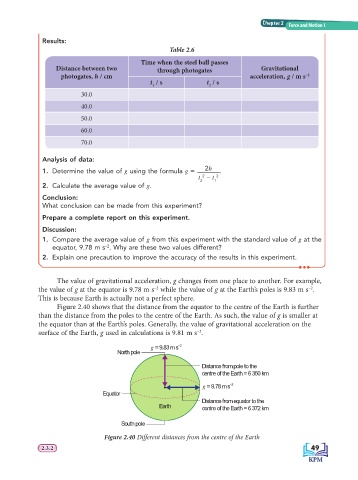
                        Figure 2.40 shows that the distance from the equator to the centre of the Earth is further
                  than the distance from the poles to the centre of the Earth. As such, the value of g is smaller at
                  the equator than at the Earth’s poles. Generally, the value of gravitational acceleration on the
                                                                  –2
                  surface of the Earth, g used in calculations is 9.81 m s .
                                                    g = 9.83 m s –2
                                          North pole

                                                                    Distance from pole to the
                                                                    centre of the Earth = 6 350 km
                                                                    g = 9.78 m s –2
                                      Equator
                                                                    Distance from equator to the
                                                       Earth        centre of the Earth = 6 372 km

                                           South pole

                                      Figure 2.40 Different distances from the centre of the Earth
                                                                                                    49
                   2.3.2
                   2.3.2                                                                            49

