


Page 56 - text book form physics kssm 2020
P. 56
Solving Problems Related to Free Falling Objects

                      Objects thrown vertically upwards or released and falls
                 downwards experience gravitational acceleration, g. Therefore,   Object thrown  Assumption:
                 the equations of linear motion below can be applied to free   upwards      Motion in the
                 falling objects.                                                           positive direction

                                              1
                          v = u + gt   s = ut +  gt  2  v  = u  + 2gs
                                                        2
                                                            2
                                              2                                                 Object
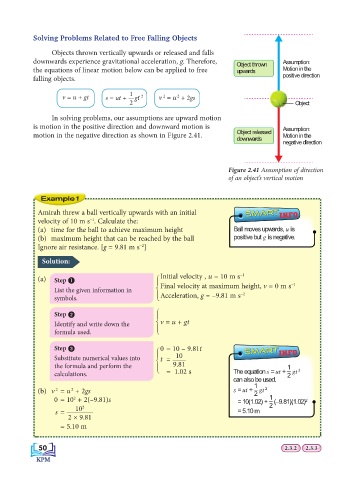
                      In solving problems, our assumptions are upward motion
                 is motion in the positive direction and downward motion is                 Assumption:
                 motion in the negative direction as shown in Figure 2.41.    Object released   Motion in the
                                                                              downwards
                                                                                            negative direction


                                                                           Figure 2.41 Assumption of direction
                                                                           of an object’s vertical motion


                   Example 1
                                                                                SMART
                  Amirah threw a ball vertically upwards with an initial        SMART      INFO
                                  –1
                  velocity of 10 m s . Calculate the:
                  (a)  time for the ball to achieve maximum height           Ball moves upwards, u is
                  (b)  maximum height that can be reached by the ball        positive but g is negative.
                                                 –2
                  Ignore air resistance. [g = 9.81 m s ]
                   Solution:

                  (a)   Step                           Initial velocity , u = 10 m s –1
                                                       Final velocity at maximum height, v = 0 m s –1
                       List the given information in                           –2
                       symbols.                        Acceleration, g = –9.81 m s
                                                      123
                       Step
                                                       v = u + gt
                       Identify and write down the
                       formula used.
                                                      123
                       Step                            0 = 10 – 9.81t           SMART      INFO
                                                                                SMART
                       Substitute numerical values into   123 t =   10
                       the formula and perform the         9.81                              1  2
                       calculations.                     =  1.02 s           The equation s = ut +   gt
                                                                                             2
                                                                             can also be used.
                                                                                   1
                  (b)  v  = u  + 2gs                                          s = ut +   gt  2
                            2
                        2
                                                                                   2
                                                                                        1
                       0 = 10  + 2(–9.81)s                                     = 10(1.02) +  (–9.81)(1.02) 2
                             2
                             10 2                                              = 5.10 m  2
                       s =
                           2 × 9.81
                            = 5.10 m
                  50
                  50                                                                        2.3.2  2.3.3
                                                                                                   2.3.3
                                                                                            2.3.2

