


Page 59 - text book form physics kssm 2020
P. 59
Bab 2
                                                                                      Chapter 2  Daya dan Gerakan Iorce and Motion I
                                                                                              F
                  Recognising the Relationship between Inertia and Mass
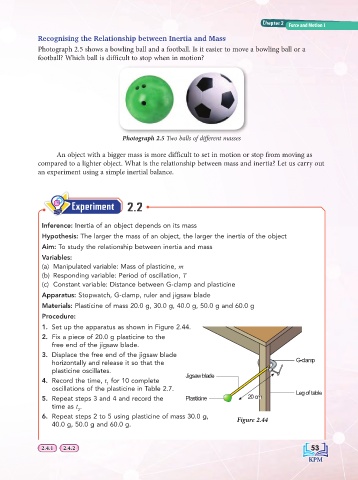
                  Photograph 2.5 shows a bowling ball and a football. Is it easier to move a bowling ball or a
                  football? Which ball is difficult to stop when in motion?


                                            Photograph 2.5 Two balls of different masses

                        An object with a bigger mass is more difficult to set in motion or stop from moving as
                  compared to a lighter object. What is the relationship between mass and inertia? Let us carry out
                  an experiment using a simple inertial balance.


                            Experiment       2.2


                   Inference: Inertia of an object depends on its mass
                   Hypothesis: The larger the mass of an object, the larger the inertia of the object
                   Aim: To study the relationship between inertia and mass
                   Variables:
                   (a)  Manipulated variable: Mass of plasticine, m
                   (b)  Responding variable: Period of oscillation, T
                   (c)  Constant variable: Distance between G-clamp and plasticine
                   Apparatus: Stopwatch, G-clamp, ruler and jigsaw blade
                   Materials: Plasticine of mass 20.0 g, 30.0 g, 40.0 g, 50.0 g and 60.0 g
                   Procedure:
                   1.  Set up the apparatus as shown in Figure 2.44.
                   2.  Fix a piece of 20.0 g plasticine to the
                      free end of the jigsaw blade.
                   3.  Displace the free end of the jigsaw blade
                      horizontally and release it so that the                                   G-clamp
                      plasticine oscillates.
                                                               Jigsaw blade
                   4.  Record the time, t  for 10 complete
                                       1
                      oscillations of the plasticine in Table 2.7.                              Leg of table
                                                                                 20 cm
                   5.  Repeat steps 3 and 4 and record the     Plasticine        20 cm
                      time as t .
                              2
                   6.  Repeat steps 2 to 5 using plasticine of mass 30.0 g,
                      40.0 g, 50.0 g and  60.0 g.                             Figure 2.44


                                                                                                    53
                   2.4.1  2.4.2                                                                     53
                          2.4.2
                   2.4.1

