


Page 60 - text book form physics kssm 2020
P. 60
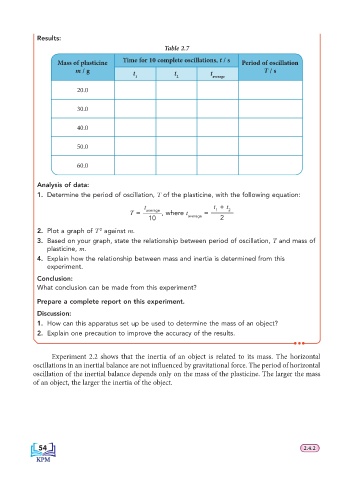
Results:

                                                        Table 2.7
                        Mass of plasticine  Time for 10 complete oscillations, t / s  Period of oscillation
                             m / g                                                    T / s
                                               t 1         t 2        t average
                              20.0


                              30.0

                              40.0

                              50.0


                              60.0

                  Analysis of data:
                  1.  Determine the period of oscillation, T of the plasticine, with the following equation:

                                                  t                    t  + t
                                              T =   average  , where t   =   1  2
                                                   10          average   2
                  2.  Plot a graph of T   against m.
                                     2
                  3.  Based on your graph, state the relationship between period of oscillation, T and mass of
                     plasticine, m.
                  4.  Explain how the relationship between mass and inertia is determined from this
                     experiment.
                  Conclusion:
                  What conclusion can be made from this experiment?
                  Prepare a complete report on this experiment.

                  Discussion:
                  1.  How can this apparatus set up be used to determine the mass of an object?
                  2.  Explain one precaution to improve the accuracy of the results.


                      Experiment 2.2 shows that the inertia of an object is related to its mass. The horizontal
                 oscillations in an inertial balance are not influenced by gravitational force. The period of horizontal
                 oscillation of the inertial balance depends only on the mass of the plasticine. The larger the mass
                 of an object, the larger the inertia of the object.


                  54
                  54                                                                              2.4.2
                                                                                                  2.4.2

