


Page 92 - demo
P. 92
BOOK IN SERIES


            thrusts.  Old  and  expensive  types  of  gear  pumps  (made
            up of perfectly smooth lateral faces and a stator with very
            precise shim adjustments) were replaced by radial and axial
            compensation  pumps,  also  known  as  self-balancedpumps,
            which  consist  of  a  casing  and  balancing  bushings  made  of
            aluminium  alloy,  treated  steel  gearwheels  and  front  seals
            made of reinforced nitrile mixture or viton.

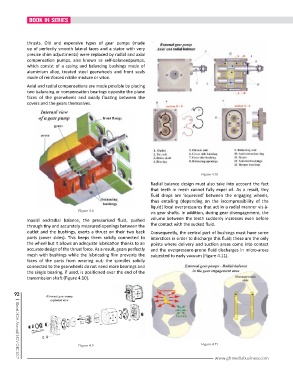
            Axial and radial compensations are made possible by placing
            two balancing or compensation bearings opposite the plane
            faces  of  the  gearwheels  and  axially  floating  between  the
            covers and the gears themselves.


                                                                                     Figure 4.10
                                                                Radial balance design must also take into account the fact
                                                                that  teeth  in  mesh  cannot  fully  expel  oil.  As  a  result,  tiny
                                                                fluid  drops  are  ‘squeezed’  between  the  engaging  wheels,
                                                                thus  entailing  (depending  on  the  incompressibility  of  the
                                                                liquid) local overpressures that act in a radial manner vis-à-
                                  Figure 4.8                    vis gear shafts. In addition, during gear disengagement, the

            Inaxial  andradial  balance,  the  pressurised  fluid,  pushed   volume between the teeth suddenly increases even before
            through tiny and accurately measured openings between the   the contact with the sucked fluid.
            outlet and the bushings, exerts a thrust on their two back  Consequently, the central part of bushings must have some
            parts  (cover  sides).  This  keeps  them  solidly  connected  to  interstices in order to discharge this fluid; these are the only
            the wheel but it allows an adequate lubrication thanks to an  points where delivery and suction areas come into contact
            accurate design of the thrust force. As a result, gears perfectly  and the overpressure-prone fluid discharges in micro-areas
            mesh with bushings while the lubricating film prevents the  subjected to early vacuum (Figure 4.11).
            faces  of  the  parts  from  wearing  out;  the  spindles  solidly
            connected to the gearwheels do not need more bearings and
            the single bearing, if used, is positioned over the end of the
            transmission shaft (Figure 4.10).


       92


                                  Figure 4.9                                         Figure 4.11

                                                                                           www.ghmediabusiness.com
        |  Global MDA Journal | NOV-DEC 2017

