


Page 93 - demo
P. 93
BOOK IN SERIES


                                                               Some  systems  need  the  direction  reverse  of  the  prime
                                                               mover  but  their  wheels  cannot  be  inverted;  under  these
                                                               circumstances  gear  pumps  known  as  reversible  pumps  are
                                                               employed because their inlets can turn into the outlets and
                                                               vice versa as they have the same bore.
                                                               Standard  gear  pumps  (Figure  4.14)  usually  have  the
                                                               following characteristics:
                                                               l Working pressure up to 250 bar
                                                               l  Peak pressure up to 280 bar

                                                               l  Rotational speed 500 ÷ 3000 rpm
                                                               l  Absolute suction pressure 0.75 ÷ 0.85 bar

                                Figure 4.12                    l Fluid viscosity 15 ÷ 150 cSt
                                                               l Overall efficiency 0.75 ÷ 0.85
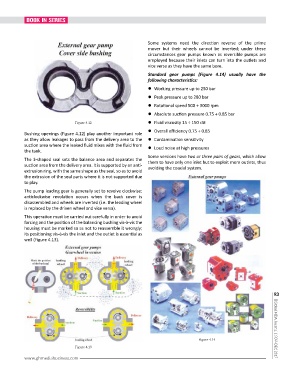
           Bushing openings (Figure 4.12) play another important role
           as they allow leakages to pass from the delivery area to the  l Contamination sensitivity
           suction area where the leaked fluid mixes with the fluid from   l Loud noise at high pressures
           the tank.
                                                               Some versions have two or three pairs of gears, which allow
           The 3-shaped seal sets the balance area and separates the   them to have only one inlet but to exploit more outlets, thus
           suction area from the delivery area. It is supported by an anti-  avoiding the coaxial system.
           extrusion ring, with the same shape as the seal, so as to avoid
           the extrusion of the seal parts where it is not supported due
           to play.
           The pump leading gear is generally set to revolve clockwise;
           anticlockwise  revolution  occurs  when  the  back  cover  is
           disassembled and wheels are inverted (i.e. the leading wheel
           is replaced by the driven wheel and vice versa).
           This operation must be carried out carefully in order to avoid
           forcing and the position of the balancing bushing vis-à-vis the
           housing must be marked so as not to reassemble it wrongly;
           its positioning vis-à-vis the inlet and the outlet is essential as
           well (Figure 4.13).


                                                                                                                   93


                                                                                    Figure 4.14                     | Global MDA Journal | NOV-DEC 2017
                                Figure 4.13

           www.ghmediabusiness.com

