


Page 91 - demo
P. 91
BOOK IN SERIES


           Yet,  these  pumps  have  some  drawbacks  too,  i.e.  a  design  Bearings or bushings are positioned in the two coversopposite
           focused on sustaining around 150 – 280 bar, their unsuitability  the stator where gear spindles revolve; the transmission shaft
           for high flow applications, rather loud noise and a rather poor  between the prime mover and the pilot wheel is in the hole
           overall efficiency.                                 of the front cover provided with a static seal (see Figure 4.9
           Nonetheless,  the  strong  demand  for  these  hydraulic   and Figure 4.10). Like in most rotary and reciprocating pumps,
           generators  prompts  manufacturers  to  carry  out  research   the inlet has a larger bore than the outlet and both of them
           and improve their products by employing special materials,   are usually positioned one opposite the otheron the stator
           accurate  heat  treatments,  minimum  coupling  tolerance   housing.
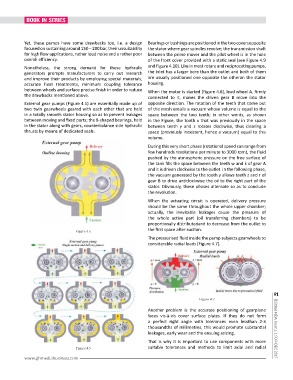
           between wheels and surface precise finish in order to reduce   When the motor is started (Figure 4.6), lead wheel A, firmly
           the drawbacks mentioned above.                      connected  to  it,  makes  the  driven  gear  B  move  into  the
           External gear pumps (Figure 4.5) are essentially made up of  opposite direction. The rotation of the teeth that come out
           two twin gearwheels geared with each other that are held  of the mesh entails a vacuum whose volume is equal to the
           in a totally smooth stator housing so as to prevent leakages  space  between  the  two  teeth;  in  other  words,  as  shown
           between moving and fixed parts; the 8-shaped bearings, held  in the Figure, the tooth x that was previously in the space
           in the stator along with gears, counterbalance side hydraulic  between  teeth  y  and  z  rotates  clockwise,  thus  clearing  a
           thrusts by means of dedicated seals.                space (previously inexistent, hence a vacuum) equal to this
                                                               volume.
                                                               During this very short phase (rotational speed can range from
                                                               few hundreds revolutions per minute to 3000 rpm), the fluid
                                                               pushed by the atmospheric pressure on the free surface of
                                                               the tank fills the space between the teeth w and k of gear A
                                                               and it is driven clockwise to the outlet. In the following phase,
                                                               the vacuum generated by the tooth y allows teeth z and r of
                                                               gear B to drive anticlockwise the oil to the right part of the
                                                               stator. Obviously, these phases alternate so as to conclude
                                                               the revolution.

                                                               When  the  actuating  circuit  is  operated,  delivery  pressure
                                                               should be the same throughout the whole upper chamber;
                                                               actually,  the  inevitable  leakages  cause  the  pressure  of
                                                               the  whole  active  part  (oil  transferring  chambers)  to  be
                                                               proportionally distributedand to decrease from the outlet to
                                                               the first space after suction.
                                 Figure 4.5
                                                               The pressurised fluid inside the pump subjects gearwheels to
                                                               considerable radial loads (Figure 4.7).


                                                                                                                   91
                                                                                    Figure 4.7
                                                               Another  problem  is  the  accurate  positioning  of  gearplane
                                                               faces  vis-à-vis  cover  surface  plates.  If  they  do  not  form
                                                               a  perfect  right  angle  with  tolerances  even  lessthan  2-3
                                                               thousandths of millimetres, this would promote substantial
                                                               leakages, early wear and the ensuing seizing.        | Global MDA Journal | NOV-DEC 2017
                                                               That  is  why  it  is  important  to  use  components  with  more
                                 Figure 4.5                    suitable  tolerances  and  methods  to  limit  axial  and  radial

           www.ghmediabusiness.com

