


Page 47 - Hamlet: The Cambridge Dover Wilson Shakespeare
P. 47
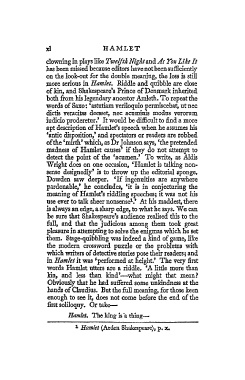
xl                 HAMLET

                clowning in plays like Twelfth Night and As You Like It
                has been missed because editors have not been sufficiently
                on the look-out for the double meaning, the loss is still
                more serious in Hamlet. Riddle and quibble are close
                of kin, and Shakespeare's Prince of Denmark inherited
                both from his legendary ancestor Amleth. To repeat the
                words of Saxo: 'astutiam veriloquio permiscebat, ut nee
                dictis veracitas deesset, nee acuminis modus verorum
                iudicio proderetur.' It would be difficult to find a more
                apt description of Hamlet's speech when he assumes his
                'antic disposition,' and spectators or readers are robbed
                of the 'mirth' which, as Dr Johnson says, 'the pretended
                madness of Hamlet causes' if they do not attempt to
                detect the point of the 'acumen.' To write, as Aldis
                Wright does on one occasion, 'Hamlet is talking non-
                sense designedly' is to throw up the editorial sponge.
                Dowden saw deeper. 'If ingenuities are anywhere
                pardonable,' he concludes, 'it is in conjecturing the
                meaning of Hamlet's riddling speeches; it was not his
                                           1
                use ever to talk sheer nonsense .' At his maddest, there
                is always an edge, a sharp edge, to what he says. We can
                be sure that Shakespeare's audience realised this to the
                full, and that the judicious among them took great
                pleasure in attempting to solve the enigmas which he set
                them. Stage-quibbling was indeed a kind of game, like
                the modern crossword puzzle or the problems with
                which writers of detective stories pose their readers; and
                in Hamlet it was 'performed at height' The very first
                words Hamlet utters are a riddle. 'A little more than
                kin, and less than kind'—what might that mean?
                Obviously that he had suffered some unkindness at the
                hands of Claudius. But the full meaning, for those keen
                enough to see it, does not come before the end of the
                first soliloquy. Or take—

                       Hamlet. The king is a thing—
                         1
                           Hamlet (Arden Shakespeare), p. x.

