


Page 86 - CASE_Toolkit_Book
P. 86
Name of your activity


               Choosing  a  name  for  the  art-science  activity  is  a  fun  and  important  part  of  your  process.  We
               recommend  involving  your  students  in  this  choice.  This  allows  students  to  experience  ownership
               towards the activity and its content.

               There is no “correct” way to name your activity. Including an element of science and an element of
               arts in the activity’s name is a good way to indicate to those involved what the nature of the activity
               is. Some suggestions may be “the Drama of Jupiter” or “Animation for the Seasons”.

                About the activity


               A general description of the activity should be included in this section. Some important  issues to
               address are how you plan to bring together elements of science and art education; why you consider
               this to be a creative activity; an explanation of what you expect the students to learn; and added
               values for the students beyond the curriculum (e.g. how they may interact socially during the activity,
               potential to support critical thinking skills, etc.).

                Implementation phases – General overview


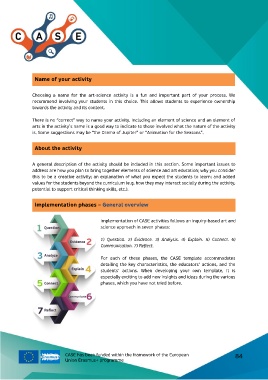
                                              Implementation of CASE activities follows an inquiry-based art and
                                              science approach in seven phases:

                                              1)  Question.  2)  Evidence.  3)  Analysis.  4)  Explain.  5)  Connect.  6)
                                              Communication. 7) Reflect.

                                              For  each  of  these  phases,  the  CASE  template  accommodates
                                              detailing  the  key  characteristics,  the  educators’ actions,  and  the
                                              students’  actions.  When  developing  your  own  template,  it  is
                                              especially exciting to add new insights and ideas during the various
                                              phases, which you have not tried before.


                              CASE has been funded within the framework of the European                   84
                              Union Erasmus+ programme

