


Page 289 - (DK Eyewitness) Travel Guide - Morocco
P. 289
MOR OC C O REGION B Y REGION 287
SOUTHERN MOROCCO
& WESTERN SAHARA
The vast southwestern region of Morocco embraces a variety
of spectacular landscapes. The fertile Souss plain, an area
dotted with oases and extensive stony deserts, is bordered
by the rugged mountains of the Anti-Atlas. On the southern
Atlantic coast, sheer cliffs give way to large areas of dunes
linking Morocco to the Sahara and the republic
of Mauritania.
Six thousand years ago, hunters forced civilians reasserted Morocco’s claim to
northwards by the desertification of the region (see p62).
the Sahara moved into southwestern The great Souss plain, east of Agadir, lies
Morocco, as shown by the thousands at the heart of this isolated region. The
of rock engravings that have been commercially grown fruit and vegetables
discovered in the Anti-Atlas. The Arab here are irrigated by the underground
conquest in the 7th century inaugurated waters of Wadi Souss, and the surrounding
the age of the independent kingdoms. argan trees provide food for herds of black
An important point for trans-Saharan goats. To the south, the Anti-Atlas is the
trade between Morocco and Timbuctu, final mountainous barrier before the
the Atlantic coast was coveted from the Sahara. Its almost surreal geological folds,
15th century by the Portuguese and the shaped by erosion, alternate with verdant
Spaniards, who eventually colonized it oases. Stone-built villages, often with an
in the late 19th century, re-naming it agadir (fortified granary), cluster along
Río de Oro (Golden River). wadis or at the foot of mountains. Further
When Spain withdrew from western south, the wide deserted beaches are
Sahara in 1975, King Hassan II initia ted sometimes cut off by lagoons that attract
the Green March during which 350,000 thousands of migratory birds.
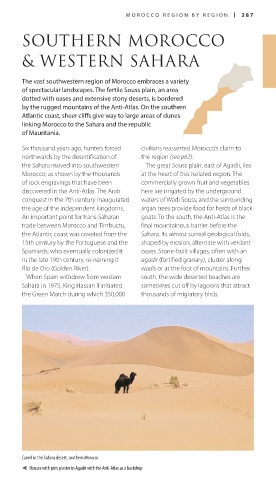
Camel in the Sahara desert, southern Morocco
Houses with pink plaster in Agadir with the Anti-Atlas as a backdrop
286-287_EW_Moroco.indd 287 14/08/14 1:08 PM

