


Page 58 - All About History - Issue 186-19
P. 58
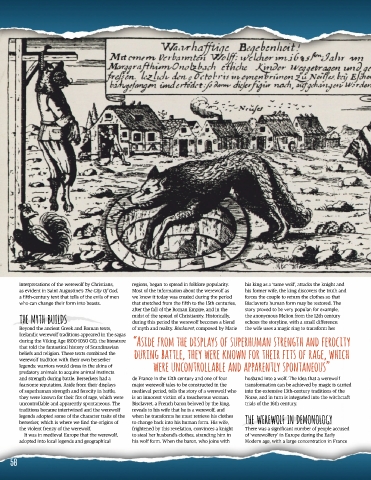
interpretations of the werewolf by Christians,        regions, began to spread in folklore popularity.       his king as a ‘tame wolf’, attacks the knight and
          as evident in Saint Augustine’s The City Of God,      Most of the information about the werewolf as          his former wife, the king discovers the truth and
          a fifth-century text that tells of the evils of men   we know it today was created during the period         forces the couple to return the clothes so that
          who can change their form into beasts.                that stretched from the fifth to the 15th centuries,   Bisclavret’s human form may be restored. The
                                                                after the fall of the Roman Empire, and in the         story proved to be very popular: for example,
          THE MYTH BUILDS                                       midst of the spread of Christianity. Historically,     the anonymous Melion from the 12th century
                                                                                                                       echoes the storyline, with a small difference:
                                                                during this period the werewolf becomes a blend
          Beyond the ancient Greek and Roman texts,             of myth and reality. Bisclavret, composed by Marie     the wife uses a magic ring to transform her
          Icelandic werewolf traditions appeared in the sagas
          during the Viking Age (800-1050 CE), the literature    “Aside from the displays of superhuman strength and ferocity
          that told the fantastical history of Scandinavian
          beliefs and religion. These texts combined the         during battle, they were known for their fits of rage, which
          werewolf tradition with their own berserker
          legends: warriors would dress in the skins of                    were uncontrollable and apparently spontaneous”
          predatory animals to acquire animal instincts
          and strength during battle. Berserkers had a          de France in the 12th century and one of four          husband into a wolf. The idea that a werewolf
          fearsome reputation. Aside from their displays        major werewolf tales to be constructed in the          transformation can be achieved by magic is carried
          of superhuman strength and ferocity in battle,        medieval period, tells the story of a werewolf who     into the extensive 13th-century traditions of the
          they were known for their fits of rage, which were    is an innocent victim of a treacherous woman.          Norse, and in turn is integrated into the witchcraft
          uncontrollable and apparently spontaneous. The        Bisclavret, a French baron beloved by the king,        trials of the 16th century.
          traditions became intertwined and the werewolf        reveals to his wife that he is a werewolf, and
          legends adopted some of the character traits of the   when he transforms he must retrieve his clothes        THE WEREWOLF IN DEMONOLOGY
          berserker, which is where we find the origins of      to change back into his human form. His wife,
          the violent frenzy of the werewolf.                   frightened by this revelation, convinces a knight      There was a significant number of people accused
             It was in medieval Europe that the werewolf,       to steal her husband’s clothes, stranding him in       of ‘werewolfery’ in Europe during the Early
          adopted into local legends and geographical           his wolf form. When the baron, who joins with          Modern age, with a large concentration in France


      58

