


Page 59 - All About History - Issue 186-19
P. 59
The History Of Werewolves


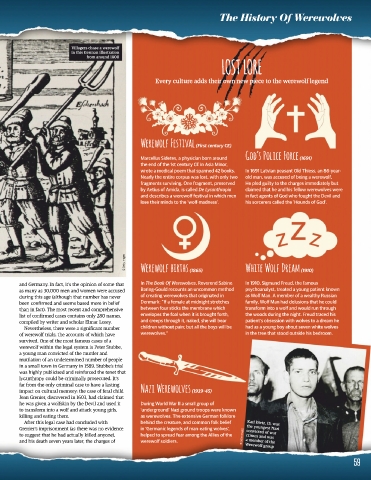
                                   Villagers chase a werewolf
                                   in this German illustration
                                                                                                           LOST LORE
                                           from around 1800


                                                                            Every culture adds their own new piece to the werewolf legend


                                                                    Werewolf Festival (First century CE)


                                                                    Marcellus Sidetes, a physician born around         God’s Police Force (1691)
                                                                    the end of the 1st century CE in Asia Minor,
                                                                    wrote a medical poem that spanned 42 books.        In 1691 Latvian peasant Old Thiess, an 86-year-
                                                                    Nearly the entire corpus was lost, with only two   old man, was accused of being a werewolf.
                                                                    fragments surviving. One fragment, preserved       He pled guilty to the charges immediately but
                                                                    by Aetius of Amida, is called De Lycanthropia      claimed that he and his fellow werewolves were
                                                                    and describes a werewolf festival in which men     in fact agents of God who fought the Devil and
                                                                    lose their minds to the ‘wolf-madness’.            his sorcerers called the ‘Hounds of God’.


                                                             © Getty Images  Werewolf births (1865)                    White Wolf Dream (1910)


          and Germany. In fact, it’s the opinion of some that       In The Book Of Werewolves, Reverend Sabine         In 1910, Sigmund Freud, the famous
          as many as 30,000 men and women were accused              Baring-Gould recounts an uncommon method           psychoanalyst, treated a young patient known
          during this age (although that number has never           of creating werewolves that originated in          as Wolf Man. A member of a wealthy Russian
          been confirmed and seems based more in belief             Denmark: “If a female at midnight stretches        family, Wolf Man had delusions that he could
          than in fact). The most recent and comprehensive          between four sticks the membrane which             transform into a wolf and would run through
          list of confirmed cases contains only 280 names,          envelopes the foal when it is brought forth,       the woods during the night. Freud traced his
          compiled by writer and scholar Elmar Lorey.               and creeps through it, naked, she will bear        patient’s obsession with wolves to a dream he
             Nevertheless, there were a significant number          children without pain; but all the boys will be    had as a young boy about seven white wolves
          of werewolf trials, the accounts of which have            werewolves.”                                       in the tree that stood outside his bedroom.
          survived. One of the most famous cases of a
          werewolf within the legal system is Peter Stubbe,
          a young man convicted of the murder and
          mutilation of an undetermined number of people
          in a small town in Germany in 1589. Stubbe’s trial
          was highly publicised and reinforced the tenet that
          lycanthropy could be criminally prosecuted. It’s
          far from the only criminal case to have a lasting
          impact on cultural memory: the case of feral child        Nazi Werewolves (1939-45)
          Jean Grenier, discovered in 1603, had claimed that
          he was given a wolfskin by the Devil and used it          During World War II a small group of
          to transform into a wolf and attack young girls,          ‘underground’ Nazi ground troops were known
          killing and eating them.                                  as werewolves. The extensive German folklore
             After this legal case had concluded with               behind the creature, and common folk belief         Karl Dietz, 15, was
          Grenier’s imprisonment (as there was no evidence          in ‘Germanic legends of man-eating wolves’,
                                                                                                                       convicted of war
          to suggest that he had actually killed anyone),           helped to spread fear among the Allies of the    © Getty Images the youngest Nazi
                                                                                                                       crimes and was
          and his death seven years later, the charges of           werewolf soldiers.                                 Werewolf group
                                                                                                                       a member of the


                                                                                                                                                                           59

