


Page 62 - All About History - Issue 186-19
P. 62
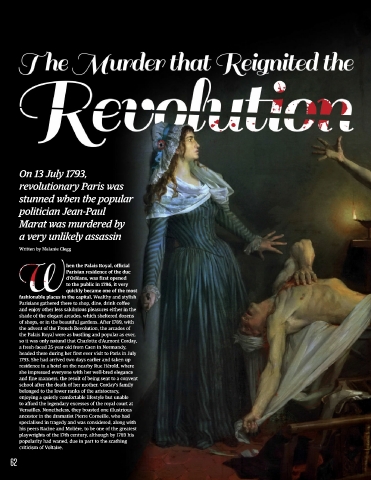
On 13 July 1793,

          revolutionary Paris was


          stunned when the popular


          politician Jean-Paul


          Marat was murdered by


          a very unlikely assassin


          Written by Melanie Clegg


                                 hen the Palais Royal, official
                                 Parisian residence of the duc
                                 d’Orléans, was first opened
                                 to the public in 1786, it very
                                 quickly became one of the most
          fashionable places in the capital. Wealthy and stylish
          Parisians gathered there to shop, dine, drink coffee
          and enjoy other less salubrious pleasures either in the
          shade of the elegant arcades, which sheltered dozens
          of shops, or in the beautiful gardens. After 1789, with
          the advent of the French Revolution, the arcades of
          the Palais Royal were as bustling and popular as ever,
          so it was only natural that Charlotte d’Aumont Corday,
          a fresh-faced 25-year-old from Caen in Normandy,
          headed there during her first ever visit to Paris in July
          1793. She had arrived two days earlier and taken up
          residence in a hotel on the nearby Rue Hérold, where
          she impressed everyone with her well-bred elegance
          and fine manners, the result of being sent to a convent
          school after the death of her mother. Corday’s family
          belonged to the lower ranks of the aristocracy,
          enjoying a quietly comfortable lifestyle but unable
          to afford the legendary excesses of the royal court at
          Versailles. Nonetheless, they boasted one illustrious
          ancestor in the dramatist Pierre Corneille, who had
          specialised in tragedy and was considered, along with
          his peers Racine and Molière, to be one of the greatest
          playwrights of the 17th century, although by 1789 his
          popularity had waned, due in part to the scathing
          criticism of Voltaire.

      62

