


Page 61 - All About History - Issue 186-19
P. 61
The History Of Werewolves


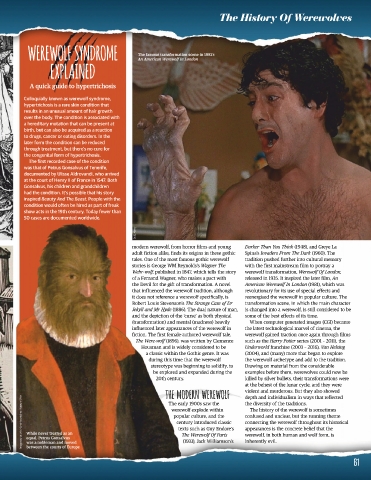
              WEREWOLFSYNDROME                                     The famous transformation scene in 1981’s


                                                                   An American Werewolf In London
                         EXPLAINED


               A quick guide to hypertrichosis


             Colloquially known as werewolf syndrome,
             hypertrichosis is a rare skin condition that
             results in an unusual amount of hair growth
             over the body. The condition is associated with
             a hereditary mutation that can be present at
             birth, but can also be acquired as a reaction
             to drugs, cancer or eating disorders. In the
             later form the condition can be reduced
             through treatment, but there’s no cure for
             the congenital form of hypertrichosis.
               The first recorded case of the condition
             was that of Petrus Gonsalvus of Tenerife,
             documented by Ulisse Aldrovandi, who arrived
             at the court of Henry II of France in 1547. Both
             Gonsalvus, his children and grandchildren
             had the condition. It’s possible that his story
             inspired Beauty And The Beast. People with the
             condition would often be hired as part of freak
             show acts in the 19th century. Today fewer than
             50 cases are documented worldwide.


                                                                  3x © Alamy


                                                                modern werewolf, from horror films and young           Darker Than You Think (1948), and Greye La
                                                                adult fiction alike, finds its origins in these gothic  Spina’s Invaders From The Dark (1960). The
                                                                tales. One of the most famous gothic werewolf          tradition pushed further into cultural memory
                                                                stories is George WM Reynolds’s Wagner The             with the first mainstream film to portray a
                                                                Wehr-wolf, published in 1847, which tells the story    werewolf transformation, Werewolf Of London,
                                                                of a Fernand Wagner, who makes a pact with             released in 1935. It inspired the later film, An
                                                                the Devil for the gift of transformation. A novel      American Werewolf In London (1981), which was
                                                                that influenced the werewolf tradition, although       revolutionary for its use of special effects and
                                                                it does not reference a werewolf specifically, is      reenergised the werewolf in popular culture. The
                                                                Robert Louis Stevenson’s The Strange Case of Dr        transformation scene, in which the main character
                                                                Jekyll and Mr Hyde (1886). The dual nature of man,     is changed into a werewolf, is still considered to be
                                                                and the depiction of the ‘curse’ as both physical      some of the best effects of its time.
                                                                (transformation) and mental (madness) heavily            When computer generated images (CGI) became
                                                                influenced later appearances of the werewolf in        the latest technological marvel of cinema, the
                                                                fiction. The first female-authored werewolf tale,      werewolf gained traction once again through films
                                                                  The Were-wolf (1896), was written by Clemence        such as the Harry Potter series (2001 – 2011), the
                                                                     Housman and is widely considered to be            Underworld franchise (2003 – 2016), Van Helsing
                                                                       a classic within the Gothic genre. It was       (2004), and (many) more that began to explore
                                                                        during this time that the werewolf             the werewolf archetype and add to the tradition.
                                                                         stereotype was beginning to solidify, to      Drawing on material from the considerable
                                                                           be explored and expanded during the         examples before them, werewolves could now be
                                                                            20th century.                              killed by silver bullets, their transformations were
                                                                                                                       at the behest of the lunar cycle, and they were
                                                                                THE MODERN WEREWOLF                    violent and murderous. But they also showed
                                                                                                                       depth and individualism in ways that reflected
           Image source: wiki/Kunsthistorisches Museum Wien  While never treated as an   werewolf explode within       confused and unclear, but the running theme
                                                                                                                       the diversity of the traditions.
                                                                                  The early 1900s saw the
                                                                                                                         The history of the werewolf is sometimes
                                                                                    popular culture, and the
                                                                                                                       connecting the werewolf throughout its historical
                                                                                      century introduced classic
                                                                                                                       appearances is the concrete belief that the
                                                                                       texts such as Guy Endore’s
                                                                                                                       werewolf, in both human and wolf form, is
                                                                                        The Werewolf Of Paris
              equal, Petrus Gonsalvus
                                                                                                                       inherently evil.
                                                                                         (1933), Jack Williamson’s
              was a nobleman and moved
              between the courts of Europe
                                                                                                                                                                           61

