


Page 60 - All About History - Issue 186-19
P. 60
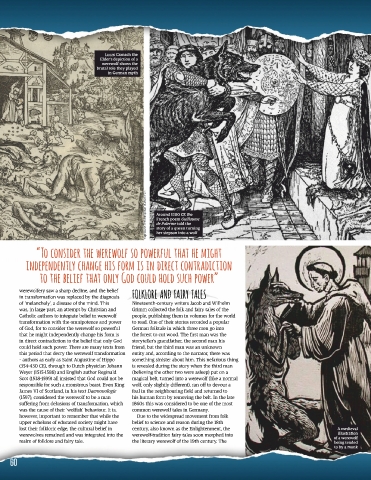
s Cranach the
                                                 Eld   depiction of a
                                                  werewolf shows the
                                               brutal role they played
                                                     in German myth


                                                                       Imagesource:TheMetropolitanMuseumofArt  Around 1200 CE the


                                                                            French poem Guillaume
                                                                            de Palerme told the
                                                                            story of a queen turning
                                                                            her stepson into a wolf


                  “To consider the werewolf so powerful that he might

             independently change his form is in direct contradiction


                    to the belief that only God could hold such power”


          werewolfery saw a sharp decline, and the belief       FOLKLORE AND FAIRY TALES
          in transformation was replaced by the diagnosis
          of ‘melancholy’, a disease of the mind. This          Nineteenth-century writers Jacob and Wilhelm
          was, in large part, an attempt by Christian and       Grimm collected the folk and fairy tales of the
          Catholic authors to integrate belief in werewolf      people, publishing them in volumes for the world
          transformation with the omnipotence and power         to read. One of their stories recorded a popular
          of God, for to consider the werewolf so powerful      German folktale in which three men go into
          that he might independently change his form is        the forest to cut wood. The first man was the
          in direct contradiction to the belief that only God   storyteller’s grandfather, the second man his
          could hold such power. There are many texts from      friend, but the third man was an unknown
          this period that decry the werewolf transformation    entity and, according to the narrator, there was
          – authors as early as Saint Augustine of Hippo        something sinister about him. This nefarious thing
          (354-430 CE), through to Dutch physician Johann       is revealed during the story when the third man
          Weyer (1515-1588) and English author Reginald         (believing the other two were asleep) put on a
          Scot (1538-1599) all insisted that God could not be   magical belt, turned into a werewolf (like a normal
          responsible for such a monstrous beast. Even King     wolf, only slightly different), ran off to devour a
          James VI of Scotland, in his text Daemonologie        foal in the neighbouring field and returned to
          (1597), considered the werewolf to be a man           his human form by removing the belt. In the late
          suffering from delusions of transformation, which     1860s this was considered to be one of the most
          was the cause of their ‘wolfish’ behaviour. It is,    common werewolf tales in Germany.
          however, important to remember that while the            Due to the widespread movement from folk
          upper echelons of educated society might have         belief to science and reason during the 18th
          lost their folkloric edge, the cultural belief in     century, also known as the Enlightenment, the                                                      A medieval
          werewolves remained and was integrated into the       werewolf-tradition fairy tales soon morphed into                                                   illustration
          realm of folklore and fairy tale.                     the literary werewolf of the 19th century. The                                                   of a werewolf
                                                                                                                                                                 being tended
                                                                                                                                                                 to by a monk


      60

