


Page 61 - (DK Eyewitness) Travel Guide - Germany
P. 61
THE HIST OR Y OF GERM AN Y 59
The tide turned for
Germany at the Battle
of Leipzig in 1813, when
Russia, Austria and Prussia
defeated the French. After
Napoleon’s final defeat at
Waterloo in 1815, the
Congress of Vienna
established a German
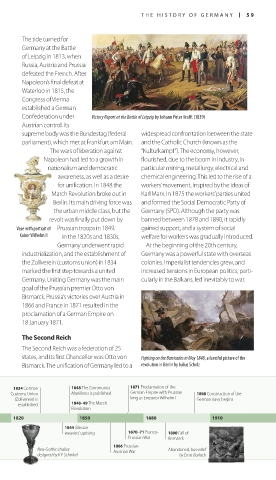
Confederation under Victory Report at the Battle of Leipzig by Johann Peter Krafft (1839)
Austrian control. Its
supreme body was the Bundestag (federal widespread confrontation between the state
parliament), which met at Frankfurt am Main. and the Catholic Church (known as the
The wars of liberation against “Kulturkampf”). The economy, however,
Napoleon had led to a growth in flourished, due to the boom in industry, in
nationalism and democratic particular mining, metallurgy, electrical and
awareness, as well as a desire chemical engineering. This led to the rise of a
for unification. In 1848 the workers’ movement, inspired by the ideas of
March Revolution broke out in Karl Marx. In 1875 the workers’ parties united
Berlin. Its main driving force was and formed the Social Democratic Party of
the urban middle class, but the Germany (SPD). Although the party was
revolt was finally put down by banned between 1878 and 1890, it rapidly
Vase with por trait of Prussian troops in 1849. gained support, and a system of social
Kaiser Wilhelm II In the 1820s and 1830s, welfare for workers was gradually introduced.
Germany underwent rapid At the beginning of the 20th century,
industrialization, and the establishment of Germany was a powerful state with overseas
the Zollverein (customs union) in 1834 colonies. Imperialist ten dencies grew, and
marked the first step towards a united increased tensions in European politics, part i
Germany. Uniting Germany was the main cularly in the Balkans, led inevitably to war.
goal of the Prussian premier Otto von
Bismarck. Prussia’s victories over Austria in
1866 and France in 1871 resulted in the
proclamation of a German Empire on
18 January 1871.
The Second Reich
The Second Reich was a federation of 25
states, and its first Chancellor was Otto von Fighting on the Barricades in May 1848, a fanciful picture of the
Bismarck. The unification of Germany led to a revolution in Berlin by Julius Scholz
1813 Battle 1834 German 1848 The Communist 1871 Proclamation of the
of the Nations Customs Union Manifesto is published German Empire with Prussian 1898 Construction of the
at Leipzig (Zollverein) is king as Emperor Wilhelm I German navy begins
established 1848–49 The March
Revolution
1790 1820 1850 1880 1910
1844 Silesian
weavers’ uprising 1870–71 Franco 1890 Fall of
Prussian War Bismarck
1866 Prussian
Neo-Gothic chalice Abandoned, bas-relief
1814–15 The Congress of Vienna Austrian War
designed by K F Schinkel by Ernst Barlach
058-059_EW_Germany.indd 59 09/10/17 12:54 pm

