


Page 58 - (DK Eyewitness) Travel Guide - Germany
P. 58
56 INTRODUCING GERM AN Y THE HIST OR Y OF GERM AN Y 57
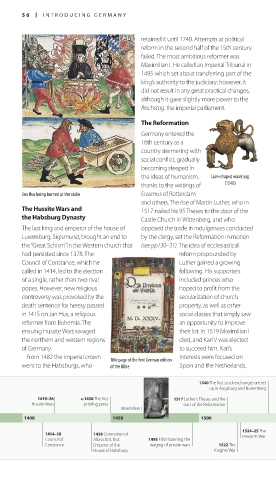
retained it until 1740. Attempts at political the religious conflicts. However, the
reform in the second half of the 15th century influence of the Counter-Reformation
failed. The most ambitious reformer was in the early 17th century ended this
Maximilian I. He called an Imperial Tribunal in stability. The Protestant Union and
1495 which set about transferring part of the Catholic League were established in
king’s authority to the judiciary; however, it 1608 and 1609 respectively. Unrest
did not result in any great practical changes, in Prague, where the states with a
although it gave slightly more power to the Protestant majority opposed the
Reichstag, the imperial parliament. election of the Catholic Ferdinand II
as king of Bohemia, began the Thirty
The Reformation Urban life in Germany in the early 16th century, in a painting by Years’ War. This religious war quickly
Germany entered the Jörg Breu the Elder (around 1475–1537) spread throughout Germany, and also
16th century as a drew in Denmark, Spain, Sweden and
country simmering with and he was unable to prevent the spread France. Much of the country and many towns
social conflict, gradually of Lutheranism. The unrest led to rebellions were laid waste, and vast numbers of people
becoming steeped in such as the Knights’ War of 1522 and the died. Finally, in 1648, the German states,
the ideas of humanism, Lion-shaped water jug Peasants’ War of 1524, and these were France and Sweden signed the Peace of
thanks to the writings of (1540) followed by continuous religious conflict. Westphalia in Münster, resulting in major
Jan Hus being burned at the stake Erasmus of Rotterdam In 1530 the Protestants set up the League of losses of territory for Germany, mainly in the
and others. The rise of Martin Luther, who in Schmalkalden, which was finally broken up north. A new political system emerged, with
The Hussite Wars and 1517 nailed his 95 Theses to the door of the by the Emperor in the war of 1546–7. These the German princes enjoying complete
the Habsburg Dynasty Castle Church in Wittenberg, and who basically religious clashes ultimately led to political independence, under a weakened
The last king and emperor of the house of opposed the trade in indulgences conducted the division of Germany into a northern emperor and pope. The second half of the
Luxemburg, Sigismund, brought an end to by the clergy, set the Reformation in motion Protestant part and a Catholic south, a 17th century was marked by the rebuilding
the “Great Schism” in the Western church that (see pp130–31). The idea of ecclesiastical situation that was sanctioned in 1555 by of towns and the hard work of restoring the
had persisted since 1378. The reform propounded by the Peace of Augsburg. This established ruined economic infrastructure.
Council of Constance, which he Luther gained a growing the principle of cuius regio,
called in 1414, led to the election following. His supporters eius religio, which meant
of a single, rather than two rival included princes who that each ruler had the
popes. However, new religious hoped to profit from the right to decide on the faith
controversy was provoked by the secularization of church of the region, and the only
death sentence for heresy passed property, as well as other option left for anyone of a
in 1415 on Jan Hus, a religious social classes that simply saw different persuasion was to
reformer from Bohemia. The an opportunity to improve move elsewhere.
ensuing Hussite Wars ravaged their lot. In 1519 Maximilian I
the northern and western regions died, and Karl V was elected The Thirty Years’ War
of Germany. to succeed him. Karl’s The second half of the
From 1482 the imperial crown Title page of the first German edition interests were focused on 16th century was relatively
went to the Habs burgs, who of the Bible Spain and the Netherlands, stable for Germany, despite A scene in the Thirty Years’ War, in a painting by Wilhelm von Diez
1540 The first stock exchanges are set 1540 The first stock exchanges are set
up in Augsburg and Nurembergup in Augsburg and Nuremberg 1609 Establishment of 1618 Thirty Monument to the
1555 Religious Peace the Catholic League Years’ War Great Elector,
1419–36 c.1450 The first 1517 Luther’s Theses and the of Augsburg breaks out Friedrich Wilhelm I
Hussite Wars printing press start of the Reformation 1608 Foundation of the
Maximilian I Protestant Union
1400 1450 1500 1550 1600 1650
1524–25 The 1524–25 The 1546 1546
1414–18 1438 Coronation of Peasants’ WarPeasants’ War Schmalkalden Schmalkalden
Council of Albrecht II, first 1495 Edict banning the War beginsWar begins 16th-century 1640 Accession to the 1648 Peace of
Constance Emperor of the waging of private wars 1522 The tile, depicting a Brandenburg throne by Westphalia ends the
House of Habsburg Knights’ War falconer Friedrich Wilhelm I Thirty Years’ War
056-057_EW_Germany.indd 56 09/10/17 12:54 pm 056-057_EW_Germany.indd 57 09/10/17 12:54 pm

