


Page 57 - (DK Eyewitness) Travel Guide - Germany
P. 57
THE HIST OR Y OF GERM AN Y 55
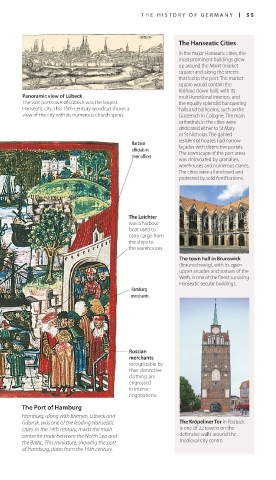
The Hanseatic Cities
In the major Hanseatic cities, the
most prominent buildings grew
up around the Markt (market
square) and along the streets
that led to the port. The market
square would contain the
Rathaus (town hall), with its
Panoramic view of Lübeck multi-functional interiors, and
The vast port town of Lübeck was the largest the equally splendid banqueting
Hanseatic city. This 15th-century woodcut shows a halls and ballrooms, such as the
view of the city with its numerous church spires. Gürzenich in Cologne. The main
cathedrals in the cities were
dedicated either to St Mary
or St Nicholas. The gabled
residential houses had narrow
Harbour façades with distinctive portals.
officials in The townscape of the port areas
their offices was dominated by granaries,
warehouses and numerous cranes.
The cities were all enclosed and
protected by solid fortifications.
The Leichter
was a harbour
boat used to
carry cargo from
the ships to
the warehouses.
The town hall in Brunswick
(Braunschweig), with its open
upper arcades and statues of the
Welfs, is one of the finest surviving
Hanseatic secular buildings.
Hamburg
merchants
Russian
merchants,
recognizable by
their distinctive
clothing, are
engrossed
in intense
negotiations.
The Port of Hamburg
Hamburg, along with Bremen, Lübeck and
Gdansk, was one of the leading Hanseatic The Kröpeliner Tor in Rostock
cities. In the 14th century, it was the main is one of 22 towers on the
centre for trade between the North Sea and defensive walls around the
the Baltic. This miniature, showing the port medieval city centre.
of Hamburg, dates from the 15th century.
054-055_EW_Germany.indd 55 09/10/17 12:54 pm

