


Page 60 - (DK Eyewitness) Travel Guide - Germany
P. 60
58 INTRODUCING GERM AN Y THE HIST OR Y OF GERM AN Y 59
European city and a centre of the The tide turned for
Enlightenment. In 1740–42, in the Germany at the Battle
Seven Years’ War, Frederick the of Leipzig in 1813, when
Great took Silesia from the Habs Russia, Austria and Prussia
burgs without major losses. In defeated the French. After
1772 he took part in the first Napoleon’s final defeat at
partition of Poland. Waterloo in 1815, the
In the second half of the 18th Congress of Vienna
century Germany produced a established a German
succession of great poets and Confederation under Victory Report at the Battle of Leipzig by Johann Peter Krafft (1839)
playwrights – figures such as Austrian control. Its
Gotthold Ephraim Lessing, supreme body was the Bundestag (federal widespread confrontation between the state
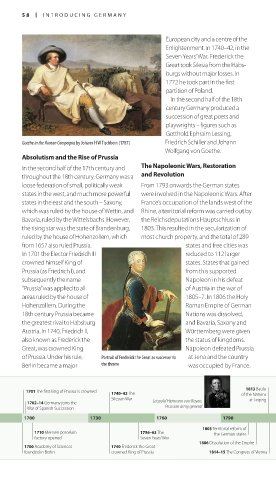
Goethe in the Roman Campagna by Johann H W Tischbein (1787) Friedrich Schiller and Johann parliament), which met at Frankfurt am Main. and the Catholic Church (known as the
Wolfgang von Goethe. The wars of liberation against “Kulturkampf”). The economy, however,
Absolutism and the Rise of Prussia Napoleon had led to a growth in flourished, due to the boom in industry, in
In the second half of the 17th century and The Napoleonic Wars, Restoration nationalism and democratic particular mining, metallurgy, electrical and
throughout the 18th century, Germany was a and Revolution awareness, as well as a desire chemical engineering. This led to the rise of a
loose federation of small, politically weak From 1793 onwards the German states for unification. In 1848 the workers’ movement, inspired by the ideas of
states in the west, and much more powerful were involved in the Napoleonic Wars. After March Revolution broke out in Karl Marx. In 1875 the workers’ parties united
states in the east and the south – Saxony, France’s occupation of the lands west of the Berlin. Its main driving force was and formed the Social Democratic Party of
which was ruled by the house of Wettin, and Rhine, a territorial reform was carried out by the urban middle class, but the Germany (SPD). Although the party was
Bavaria, ruled by the Wittelsbachs. However, the Reichsdeputations Hauptschluss in revolt was finally put down by banned between 1878 and 1890, it rapidly
the rising star was the state of Brandenburg, 1803. This resulted in the secularization of Vase with por trait of Prussian troops in 1849. gained support, and a system of social
ruled by the house of Hohenzollern, which most church property, and the total of 289 Kaiser Wilhelm II In the 1820s and 1830s, welfare for workers was gradually introduced.
from 1657 also ruled Prussia. states and free cities was Germany underwent rapid At the beginning of the 20th century,
In 1701 the Elector Friedrich III reduced to 112 larger industrialization, and the establishment of Germany was a powerful state with overseas
crowned himself King of states. States that gained the Zollverein (customs union) in 1834 colonies. Imperialist ten dencies grew, and
Prussia (as Friedrich I), and from this supported marked the first step towards a united increased tensions in European politics, part i
subsequently the name Napoleon in his defeat Germany. Uniting Germany was the main cularly in the Balkans, led inevitably to war.
“Prussia” was applied to all of Austria in the war of goal of the Prussian premier Otto von
areas ruled by the house of 1805–7. In 1806 the Holy Bismarck. Prussia’s victories over Austria in
Hohenzollern. During the Roman Empire of German 1866 and France in 1871 resulted in the
18th century Prussia became Nations was dissolved, proclamation of a German Empire on
the greatest rival to Habsburg and Bavaria, Saxony and 18 January 1871.
Austria. In 1740, Friedrich II, Württemberg were given
also known as Frederick the the status of kingdoms. The Second Reich
Great, was crowned King Napoleon defeated Prussia The Second Reich was a federation of 25
of Prussia. Under his rule, Portrait of Frederick the Great as successor to at Jena and the country states, and its first Chancellor was Otto von Fighting on the Barricades in May 1848, a fanciful picture of the
Berlin became a major the throne was occupied by France. Bismarck. The unification of Germany led to a revolution in Berlin by Julius Scholz
1813 Battle 1813 Battle 1834 German 1834 German 1848 The Communist 1871 Proclamation of the
1701 The first king of Prussia is crowned
1740–42 The of the Nations Customs Union Customs Union Manifesto is published German Empire with Prussian 1898 Construction of the
of the Nations
Silesian War at Leipzig (Zollverein) is (Zollverein) is king as Emperor Wilhelm I German navy begins
at Leipzig
1702–14 Germany joins the Leopold Hermann von Boyen, establishedestablished 1848–49 The March
War of Spanish Succession Prussian army general Revolution
1700 1730 1760 17901790 1820 1850 1880 1910
1803 Territorial reform of 1844 Silesian
1710 Meissen porcelain 1756–63 The the German states weavers’ uprising 1870–71 Franco 1890 Fall of
factory opened Seven Years’ War Prussian War Bismarck
1806 Dissolution of the Empire
1700 Academy of Sciences 1740 Frederick the Great 1866 Prussian
founded in Berlin crowned King of Prussia 1814–15 The Congress of Vienna1814–15 The Congress of Vienna Neo-Gothic chalice Austrian War Abandoned, bas-relief
designed by K F Schinkel by Ernst Barlach
058-059_EW_Germany.indd 58 09/10/17 12:54 pm 058-059_EW_Germany.indd 59 09/10/17 12:54 pm
Eyewitness Travel LAYERS PRINTED:
History Portrait template “UK” LAYER
(Source v1.2)
Date 20th August 2012
Size 125mm x 217mm

