


Page 59 - (DK Eyewitness) Travel Guide - Germany
P. 59
THE HIST OR Y OF GERM AN Y 57
the religious conflicts. However, the
influence of the Counter-Reformation
in the early 17th century ended this
stability. The Protestant Union and
Catholic League were established in
1608 and 1609 respectively. Unrest
in Prague, where the states with a
Protestant majority opposed the
election of the Catholic Ferdinand II
as king of Bohemia, began the Thirty
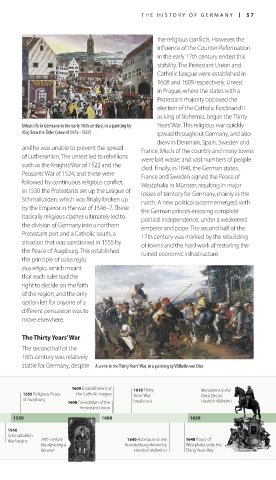
Urban life in Germany in the early 16th century, in a painting by Years’ War. This religious war quickly
Jörg Breu the Elder (around 1475–1537) spread throughout Germany, and also
drew in Denmark, Spain, Sweden and
and he was unable to prevent the spread France. Much of the country and many towns
of Lutheranism. The unrest led to rebellions were laid waste, and vast numbers of people
such as the Knights’ War of 1522 and the died. Finally, in 1648, the German states,
Peasants’ War of 1524, and these were France and Sweden signed the Peace of
followed by continuous religious conflict. Westphalia in Münster, resulting in major
In 1530 the Protestants set up the League of losses of territory for Germany, mainly in the
Schmalkalden, which was finally broken up north. A new political system emerged, with
by the Emperor in the war of 1546–7. These the German princes enjoying complete
basically religious clashes ultimately led to political independence, under a weakened
the division of Germany into a northern emperor and pope. The second half of the
Protestant part and a Catholic south, a 17th century was marked by the rebuilding
situation that was sanctioned in 1555 by of towns and the hard work of restoring the
the Peace of Augsburg. This established ruined economic infrastructure.
the principle of cuius regio,
eius religio, which meant
that each ruler had the
right to decide on the faith
of the region, and the only
option left for anyone of a
different persuasion was to
move elsewhere.
The Thirty Years’ War
The second half of the
16th century was relatively
stable for Germany, despite A scene in the Thirty Years’ War, in a painting by Wilhelm von Diez
1540 The first stock exchanges are set
up in Augsburg and Nuremberg 1609 Establishment of 1618 Thirty Monument to the
1555 Religious Peace the Catholic League Years’ War Great Elector,
of Augsburg breaks out Friedrich Wilhelm I
1608 Foundation of the
Protestant Union
1550 1600 1650
1524–25 The 1546
Peasants’ War Schmalkalden
War begins 16th-century 1640 Accession to the 1648 Peace of
tile, depicting a Brandenburg throne by Westphalia ends the
falconer Friedrich Wilhelm I Thirty Years’ War
056-057_EW_Germany.indd 57 09/10/17 12:54 pm

