


Page 146 - Ultimate Visual Dictionary (DK)
P. 146
PLANTS

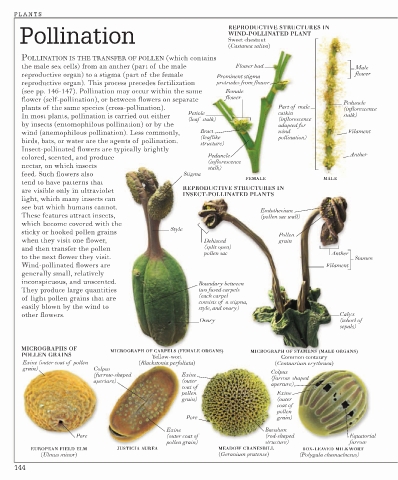
       Pollination                                              REPRODUCTIVE STRUCTURES IN
                                                                WIND-POLLINATED PLANT
                                                                Sweet chestnut
                                                                (Castanea saliva)
       POLLINATION IS THE TRANSFER OF POLLEN (which contains
       the male sex cells) from an anther (part of the male       Flower bud                        Male
       reproductive organ) to a stigma (part of the female   Prominent stigma                       flower
       reproductive organ). This process precedes fertilization   protrudes from flower
       (see pp. 146-147). Pollination may occur within the same   Female
       flower (self-pollination), or between flowers on separate   flower
                                                                                                Peduncle
       plants of the same species (cross-pollination).                        Part of  male     (inflorescence
                                                     Petiole                  catkin
       In most plants, pollination is carried out either                                        stalk)
                                                     (leaf  stalk)            (inflorescence
       by insects (entomophilous pollination) or by the                       adapted for
       wind (anemophilous pollination). Less commonly,   Bract                wind                Filament
                                                         (leaflike            pollination)
       birds, bats, or water are the agents of pollination.
                                                         structure)
       Insect-pollinated flowers are typically brightly
       colored, scented, and produce                       Peduncle                               Anther
                                                           (inflorescence
       nectar, on which insects                            stalk)
       feed. Such flowers also                      Stigma
                                                                     FEMALE                MALE
       tend to have patterns that
       are visible only in ultraviolet              REPRODUCTIVE STRUCTURES IN
                                                    INSECT-POLLINATED PLANTS
       light, which many insects can
       see but which humans cannot.
                                                                         Endothecium
       These features attract insects,                                   (pollen sac wall)
       which become covered with the
                                                Style
       sticky or hooked pollen grains
                                                                              Pollen
       when they visit one flower,                        Dehisced            grain
       and then transfer the pollen                       (split open)
                                                          pollen sac                         Anther
       to the next flower they visit.                                                               Stamen
       Wind-pollinated flowers are                                                          Filament
       generally small, relatively
       inconspicuous, and unscented.                    Boundary between
       They produce large quantities                    two fused carpels
       of light pollen grains that are                  (each carpel
                                                        consists of  a stigma,
       easily blown by the wind to                      style, and ovary)
       other flowers.                                                                          Calyx
                                                        Ovary                                  (whorl of
                                                                                               sepals)
       MICROGRAPHS OF           MICROGRAPH OF CARPELS (FEMALE ORGANS)  MICROGRAPH OF STAMENS (MALE ORGANS)
       POLLEN GRAINS                       Yellow-wort                         Common centaury
       Exine (outer coat of  pollen     (Blackstonia perfoliata)             (Centaurium erythraea)
       grain)              Colpus                                           Colpus
                           (furrow-shaped          Exine
                                                                            (furrow-shaped
                           aperture)               (outer                   aperture)
                                                   coat of
                                                   pollen                     Exine
                                                   grain)                     (outer
                                                                              coat of
                                                                              pollen
                                                     Pore                     grain)
                                               Exine                       Baculum
                      Pore                     (outer coat of              (rod-shaped            Equatorial
                                               pollen grain)               structure)             furrow
          EUROPEAN FIELD ELM      JUSTICIA AUREA              MEADOW CRANESBILL      BOX-LEAVED MILKWORT
            (Ulmus minor)                                     (Geranium pratense)   (Polygala chamaebuxus)
     144

